Client Retainer Leakage: Why Retainers Fail and How to Stop Margin Loss

Retainers are a revenue model that can generate predictable monthly revenue for agencies. However, many companies still lose margin due to retainer leakage caused by overlooked operational gaps like untracked requests, late timesheets, and scope creep. This guide explains how client retainer leakage happens, how to calculate retainer burn rate, and how to use real-time visibility to prevent margin loss.
Calculate retainer burn rate

💡 Quick Summary
- Retainer leakage occurs when a team delivers more work than a monthly retainer covers and the real cost of serving a client exceeds what the monthly agreement covers.
- The four main causes of retainer leakage are a lack of real-time consumption visibility, unbilled scope creep, reduced delivery caused by fear of overshooting, and inaccurate capacity forecasting.
- You can fix retainer leakage by using a shared live dashboard, setting consumption thresholds that trigger action, and creating an out-of-scope protocol for evaluating and approving new requests.
- Calculate Retainer Burn Rate by dividing the hours logged so far by the number of days elapsed, then multiply the result by the total days in the billing cycle. Compare the projected hours with the allocated retainer budget to identify a potential overage.
What Is Client Retainer Leakage and How to Stop It
- What Is Client Retainer Leakage?
- Why Client Retainers Fail Without Real-Time Visibility
- The 4 Main Causes of Client Retainer Leakage
- Are You Experiencing Retainer Leakage? Calculate Your Retainer Burn Rate
- How Much Retainer Leakage Comes From Delayed Tracking? What Our Data Shows
- How to Fix Retainer Leakage With Real-Time Visibility: A 3-Step Method
- How TrackingTime Helps Agencies Prevent Retainer Leakage
- How to Stop Retainer Leakage Before It Becomes a Renewal Problem
- Common Retainer Leakage Mistakes
- Conclusion: Client Retainers Need Real-Time Visibility
What Is Client Retainer Leakage?
Client retainer leakage is the margin loss that occurs when a team delivers more work than a monthly retainer covers, fails to track out-of-scope requests, or discovers budget overruns too late to correct.
Retainers can also fail in the opposite direction: under-servicing. When teams do not know how much budget remains, they may slow delivery too early to avoid an overrun. This may protect short-term margin, but it can reduce the client’s perception of value and increase renewal risk.
Why Client Retainers Fail Without Real-Time Visibility
Client retainers often fail because agencies review performance after the billing period has ended. By then, the hours have already been spent, and the margin loss cannot be prevented.
Month-end reports can explain what happened, but they do not help teams act in time. Agencies need current data to adjust scope, delivery pace, staffing, or client communication before the retainer budget is exhausted. Without live tracking, managers cannot reliably answer:
- How many retainer hours have been used?
- How many hours remain?
- Is the current pace sustainable?
- Will the retainer finish within budget?
- Are new requests still within scope?
This lack of visibility creates two risks. The agency may continue working beyond the retainer without billing the extra hours, or the team may slow delivery too early because it is unsure how much capacity remains. Both outcomes weaken the retainer.
📖 Recommended Reading
Learn how to manage client retainers effectively with a practical method for tracking hours, spotting risks of overruns, protecting margins, and supporting renewal conversations with real data.
The 4 Main Causes of Client Retainer Leakage
Retainer leakage usually starts when teams cannot see how fast hours are being consumed, which requests are driving the increase, or whether the current pace will exceed the monthly budget. These are the most common causes of retainer leakage:
1. The Real-Time Consumption Blind Spot
The main risk is not simply using too many hours. It’s noticing too late. A spike in client requests during the second week of the month can consume a large share of the retainer before anyone reviews the account. If client retainer tracking only happens after the month ends, the data becomes a retrospective audit rather than a tool for managing the work.
Tracking retainer hours in real time allows teams to compare current usage with the remaining budget and the number of days left in the billing cycle. The key question a team needs to answer is whether the current pace is likely to create retainer leakage before the month ends.
2. Unbilled Scope Creep: Silent Leakage
Scope creep often starts with small requests: an extra revision, an urgent call, a quick edit, or a last-minute task. Individually, these requests may look harmless.
Over a month, they can consume a significant share of the retainer budget without being billed separately or reflected in the original scope. When those hours are absorbed without being tracked or discussed, the agency delivers more than the retainer covers and loses margin.
📖 Recommended Read
Learn what scope creep is, why it happens, and how to prevent unpaid extra work from affecting your projects, timelines, and retainers.
3. The Fear of Overshooting Delivery Drop
Retainer leakage is not always caused by over-servicing. It can also happen when teams reduce delivery too early because they do not know how many hours remain.
Without clear visibility into the remaining budget, PMs and account managers may postpone work, limit revisions, or avoid taking on valid requests to prevent an overrun. This can make the client feel that the agency is under-delivering.
When clients do not see enough progress or output, the retainer starts to lose value from their perspective. That weakens trust, increases renewal risk, and can cause the agreement to fail even when the agency stays within budget.
4. Inaccurate Capacity Forecasting
Agencies cannot forecast capacity accurately when they do not know how quickly active retainers are consuming team hours. This creates risk across sales, operations, and finance. The agency may sign new clients while existing retainers are already using more capacity than planned. Operations may miss which accounts are overloading specific roles, and finance may overestimate margin because actual delivery costs are higher than expected.
Without reliable retainer data, hiring and resource planning become reactive. Operations leads need real-time consumption data to understand whether the team can absorb more work, where additional support is needed, and which retainers may require a scope or pricing adjustment.
Are You Experiencing Retainer Leakage? Calculate Your Retainer Burn Rate
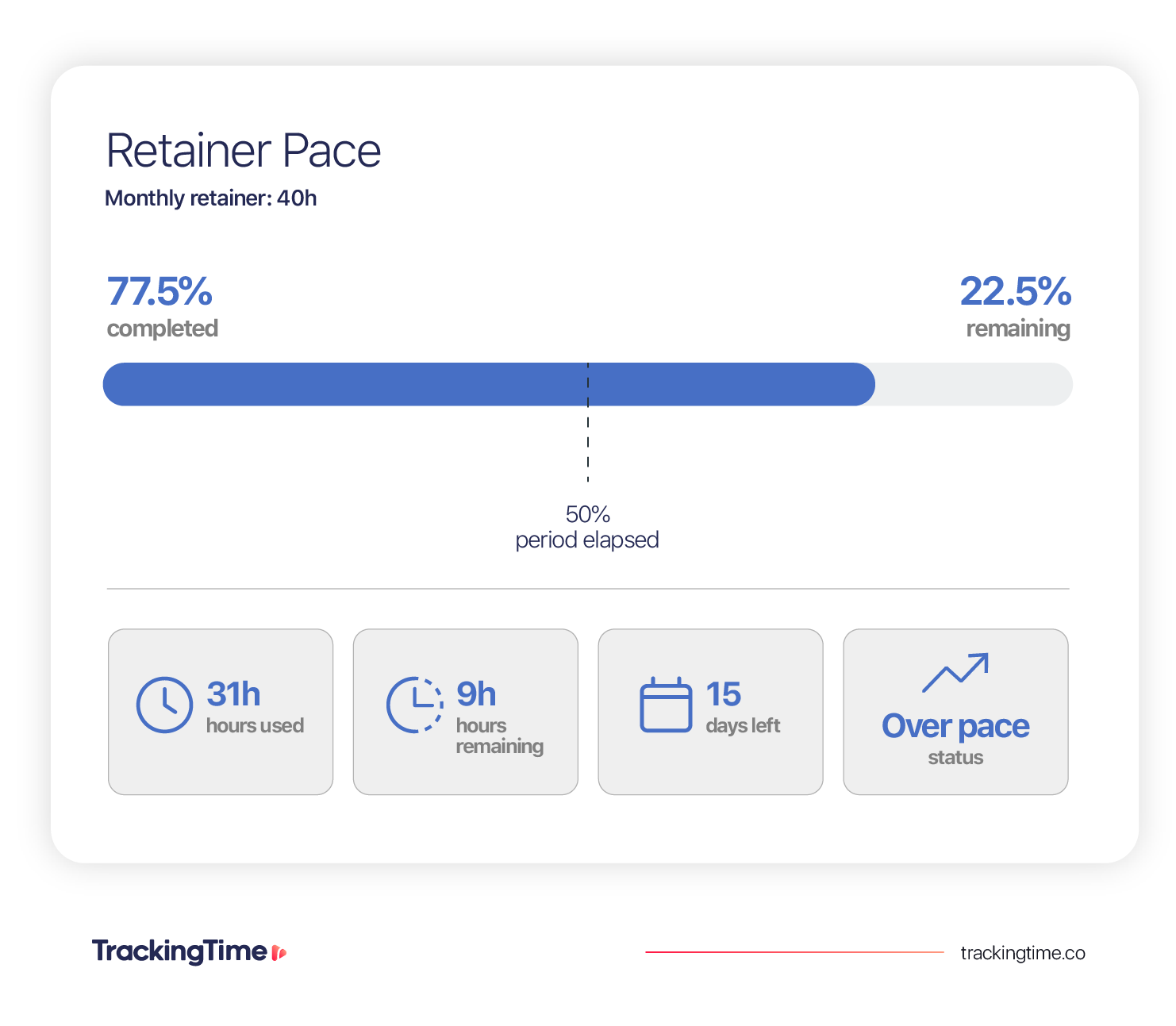
Retainer Burn Rate helps you determine whether an active retainer is on pace to stay within budget or exceed it before the billing cycle ends.
Retainer Burn Rate Calculator
Projected Retainer Hours = Current Logged Hours ÷ Days Elapsed × Total Days in Billing Cycle
Also calculates: Daily Burn Rate, Projected Utilization, and Projected Variance
Enter all four values above to project your retainer burn rate.
👉 Tip: Use the same type of days throughout the calculation. If you measure elapsed business days, use total business days in the billing cycle. If you measure calendar days, use calendar days for both variables.
👉 Planning note: This projection works best when work is distributed relatively evenly across the billing cycle. If delivery is concentrated around launches, reporting deadlines, or scheduled milestones, compare the result with the planned delivery calendar before treating it as a confirmed overrun.
How to Calculate Retainer Burn Rate
- Add all hours logged for the current retainer period.
- Divide the total by the number of days elapsed.
- Multiply the result by the total number of days in the billing cycle.
- Compare the projected hours with the allocated retainer budget.
- Calculate the projected variance to determine whether the account is under pace, within target, or at risk of leakage.
Example
A client has a 100-hour monthly retainer. By day 10 of a 30-day billing cycle, the team has logged 45 hours.
⏱️ Daily Burn Rate = 45 ÷ 10 = 4.5 hours per day
📈 Projected Retainer Hours = 4.5 × 30 = 135 hours
📊 Projected Utilization = 135 ÷ 100 × 100 = 135%
⚠️ Projected Variance = 135 − 100 = 35 hours
At the current pace, the agency is projected to exceed the retainer budget by 35 hours.
How to Interpret the Projection
- Below 90% of the allocated budget: may indicate unused capacity or under-servicing.
- Between 90% and 100%: can serve as a healthy operational target for maximizing delivery without exceeding the budget.
- Above 100%: indicates retainer leakage risk and should trigger a review of scope, delivery pace, staffing, or client communication.
The 90% to 100% range should be treated as an adjustable internal target, not a universal benchmark. The appropriate range depends on the agency’s margin requirements, contract terms, service model, and client expectations.
How Much Retainer Leakage Comes From Delayed Tracking? What Our Data Shows
According to Deltek, businesses lose an average of US$64,000 per employee every year due to lost billable hours. While this figure reflects billable-hour leakage across professional services broadly rather than retainers specifically, it illustrates how quickly untracked time compounds when hours are not captured and reviewed in real time.
How to Fix Retainer Leakage With Real-Time Visibility: A 3-Step Method
Effective agency retainer management requires a simple operating system that shows what has been used, what remains, and when action is required.

1. Use a Shared Live Dashboard
Static month-end reports arrive too late to prevent margin loss. A live dashboard gives operations, finance, project managers, and account managers a common view to identify accounts that are consuming hours too quickly, check whether upcoming work still fits the remaining budget, and decide when a scope conversation is needed.
At minimum, the dashboard should show:
- Allocated retainer hours
- Hours already consumed
- Hours remaining
- Projected burn rate
- Utilization percentage
- Out-of-scope work
- Client- or project-level breakdowns
- Projected utilization
- Projected variance against the allocated budget
- Next threshold or required action
A shared live dashboard also improves client communication. Instead of explaining an overrun after the month ends, account managers can use current data to show how the retainer is being used and discuss trade-offs before the budget is exhausted.
2. Set Amber Alert Thresholds
Real-time visibility is only useful if the team knows when to act. For that reason, a team needs to set clear consumption thresholds that trigger a specific review before the retainer is fully depleted.
| Threshold | What it means | Recommended action |
|---|---|---|
| 50% used | Mid-cycle checkpoint | Review current pace, completed work, and upcoming requests. |
| 75% used | Risk review | Confirm that the remaining deliverables still fit within the available hours. |
| 90% used | Scope conversation trigger | Pause non-urgent extras and prepare a client discussion about priorities, trade-offs, or additional work. |
| 100% used | Retainer depleted | Apply the out-of-scope protocol before the team absorbs more work. |
These thresholds are operational examples. Agencies should adjust them based on the type of retainer, delivery rhythm, margin targets, client expectations, and how evenly work is distributed across the billing cycle.
3. Create an Out-of-Scope Protocol
The next step is to establish a clear rule for handling new requests when a retainer reaches a risk threshold. At this point, PMs and account managers must know what can continue, what should pause, and who must approve additional work. A practical out-of-scope protocol should answer four questions:
- Is the request included?
Compare the request with the agreed deliverables, service categories, revision limits, and response expectations. - What will it cost in hours?
Estimate the effort before work begins, including meetings, coordination, and QA—not only execution time. - Does the retainer have enough capacity?
Check the hours remaining, planned work still outstanding, and the projected burn rate for the rest of the cycle. - Who approves the decision?
Define whether the PM, account manager, operations lead, or client must approve additional work.
The protocol should require the team to:
- Log the request in the project or retainer record.
- Estimate the total hours required.
- Identify whether it replaces existing scope or adds new work.
- Confirm the remaining retainer capacity.
- Recommend a next step before work begins.
- Escalate the request to the assigned decision-maker.
- Record the approval and update the remaining scope or budget.
Simple decision rule
| Situation | Recommended action |
|---|---|
| The request fits within the remaining hours | Approve it and update the delivery plan. |
| The request fits only if another task is removed | Swap priorities with client approval. |
| The request exceeds the remaining capacity | Bill it separately or move it to the next cycle. |
| The same request appears repeatedly | Use the pattern to adjust scope or pricing at renewal. |
| The client needs immediate delivery | Approve additional hours before work starts. |
Depending on the situation, the agency can defer the request, replace lower-priority work, bill additional hours, move the task into the next retainer cycle, or treat it as a formal change request.
Do not begin out-of-scope work until the team has documented the request, estimated the effort, and confirmed how it will affect the retainer.
How TrackingTime Helps Agencies Prevent Retainer Leakage
TrackingTime helps agencies capture retainer hours as work happens and connect time tracking with project workflows in ClickUp, Asana, Jira, and other task management tools. This reduces delayed entry and gives managers a current view of consumed hours, remaining capacity, and retainer status throughout the billing cycle.
As the team records time, consumption updates in real time. This gives project managers a current view of how much of the retainer has been used. With TrackingTime, agencies can monitor:
- Hours allocated to the retainer
- Hours already consumed
- Hours remaining in the current period
- Percentage of the retainer block consumed
- Preventive warnings before the limit is reached
- Work breakdowns by client, project, and task
- Historical consumption across retainer periods
On top of that, TrackingTime’s Shared Reports allow agencies to share a filtered view of recorded hours through a public link that does not require the client to create an account.
The report remains updated as new time is recorded and can show breakdowns by project, task, or other configured groupings. Agencies can also schedule recurring reports so clients and stakeholders receive updates without the team preparing and sending them manually. This helps agencies reduce unbilled over-servicing while giving clients better visibility into the value delivered through the retainer.
💡 Project Retainers in TrackingTime
Sign up to TrackingTime and be the first to learn about retainer tracking with TrackingTime, coming summer 2026!
How to Stop Retainer Leakage Before It Becomes a Renewal Problem
Retainer leakage becomes a renewal problem when the client first hears about it after the month has closed. At that point, the agency has limited options:
- Absorb the overage
- Reduce future delivery without context
- Ask for more budget after the work has already been completed.
A better approach is to use live retainer data to create clear decision points during the billing cycle. Here’s how to use consumption thresholds in client communications.
At 75% Consumption: Review the Remaining Work
The account manager should compare the hours left with the work still planned for the month. If the remaining work no longer fits the available hours, the team should adjust priorities before accepting more requests.
At 90% Consumption: Start the Scope Conversation
Do not wait until the retainer reaches 100%. Contact the client with a specific update that includes:
- Hours allocated
- Hours consumed
- Hours remaining
- Work already completed
- Work still planned
- Estimated hours required for new requests
👉 For example:
Retainer status
- Allocated: 100 hours
- Used: 90 hours
- Remaining: 10 hours
- Planned work: 8 hours
- New request: 6 hours
- Projected overage: 4 hours
Then give the client three clear options:
- Prioritize: Complete the highest-priority work and defer the rest.
- Swap: Replace a planned deliverable with the new request.
- Expand: Approve additional hours or move the work into the next cycle.
This way, clients can see how the retainer is being used, understand the trade-offs, and choose whether to reprioritize, defer work, or approve additional scope.
Clear visibility also reduces the risk of clients feeling under-served or unexpectedly upsold. When both sides understand the current budget and remaining capacity, the retainer becomes easier to manage and more likely to renew.
Common Retainer Leakage Mistakes
Retainer leakage often comes from small operating habits that appear harmless in isolation but repeatedly weaken margin, visibility, and client trust.
- Reviewing performance only after the month ends: By then, the hours are already spent, and the margin loss cannot be prevented.
- Treating every client request as included: Small extras can accumulate into significant unbilled work.
- Letting PMs write off small tasks: Invisible write-offs hide the real cost of serving the account.
- Tracking hours without checking the budget: Time data is not useful unless it is compared with the retainer allocation.
- Measuring utilization without projected burn: Current usage alone does not show whether the retainer will exceed budget.
- Hiding remaining hours from account managers: They cannot manage scope or client expectations without current capacity data.
- Waiting until 100% consumption to discuss scope: The conversation should happen before the budget is fully depleted.
- Relying on static reports: Month-end PDFs cannot support real-time decisions.
- Failing to document out-of-scope requests: Undocumented work is more likely to be absorbed without approval or payment.
- Using under-servicing as profit protection: Reducing delivery may protect short-term margin but increase renewal risk.
Conclusion: Client Retainers Need Real-Time Visibility
Client retainer leakage rarely comes from one major mistake. It usually builds through small untracked requests, late timesheets, extra meetings, and overages that become visible only after the budget has already been consumed.
The solution is not to make retainers rigid. It is to make retainer consumption visible while the agency still has time to adjust scope, delivery pace, staffing, or client communication.
Without real-time visibility, agencies are forced to guess whether they are over-servicing, under-servicing, or delivering at the right pace. With current data, they can protect margin, maintain delivery quality, and build more transparent client relationships.
⏱ Explore TrackingTime for Agencies
See how TrackingTime helps agencies track client work, monitor retainer consumption, and improve visibility across projects and accounts.
Frequently Asked Questions About Client Retainer Leakage
What is retainer leakage?
Client retainer leakage is the margin loss that occurs when an agency delivers more work than a monthly retainer covers, absorbs out-of-scope requests without additional billing, or discovers budget overruns too late to correct them.
How do you manage a client retainer?
Effective agency retainer management is achieved by defining scope and hour allocation, tracking work against that budget, reviewing consumption during the billing cycle, and addressing potential overages before the team performs additional work.
How do agencies track retainer hours?
Agencies track retainer hours by assigning time entries to the correct client, project, task, or service category and comparing the logged hours with the monthly retainer allocation. Live tracking also shows how many hours remain and whether the current pace will exceed the budget.
Why do client retainers fail?
Client retainers fail when agencies lack current visibility into hour consumption, absorb unplanned work without billing it, reduce delivery out of fear of exceeding the budget, or make staffing and capacity decisions using incomplete data.
What is a healthy retainer utilization rate?
A practical internal target may be 90% to 100% of the allocated retainer budget, although the appropriate range depends on the agency’s margins, delivery schedule, service model, and client agreement. It should not be treated as a universal industry benchmark.
How do you prevent scope creep in a retainer?
Prevent scope creep by documenting new requests, estimating their required hours, comparing them with the remaining retainer capacity, and deciding whether to swap, defer, or bill the work separately before the team begins.


