Overtime Explained: Meaning, Examples, and How to Manage It

Overtime is the time an employee works beyond their standard scheduled hours. It occurs when actual work time exceeds the originally planned time, including staying late, starting early, covering an extra shift, or continuing work after hours. The term can also refer to the additional pay employees receive for those extra hours.
Calculate overtime

Overtime vs Regular Hours: A Quick Comparison
| Regular Hours | Overtime | Overtime Without Tracking | |
|---|---|---|---|
| What it looks like | Work stays within the schedule | Work goes beyond standard hours | Extra time is worked but not recorded |
| When it happens | Planned workdays | Deadlines or workload peaks | After hours or unnoticed work |
| Visibility | Fully visible | Usually tracked | Often invisible |
| Team impact | Predictable workload | Can create strain if frequent | Leads to hidden overload |
| Risk level | Low | Medium | High |
💡 Quick Summary
- Overtime is the hours worked beyond a standard schedule
- It happens when workload, timing, or unexpected demands exceed the team’s available capacity.
- It can cause issues such as burnout, budget overruns, and inequity across team members.
- Extra work time needs to be tracked to avoid errors, overload, and blind spots
- Visibility is key to managing extended work time effectively
Overtime Meaning, Hours, and Management
- Overtime vs Regular Hours: A Quick Comparison
- What Is Overtime?
- How Overtime Hours Work and How They’re Calculated
- When Does Overtime Occur?
- Common Examples of Overtime (Real-world Scenarios)
- What Is Overtime Pay?
- Common Issues with Extra Work Time
- Why Tracking Extra Hours Matters for Teams
- How to Manage and Reduce Extended Work Time
- Extra Hours Are a Signal Worth Tracking
What Is Overtime?
Overtime refers to any time an employee works beyond their normal working hours. In practice, overtime is identified by comparing the hours a person was expected to work with the hours they actually worked.
Overtime can be formal or informal. It may be approved in advance, for example, to cover an extra shift, or it may happen informally when someone stays late for a tight deadline.
📊 Key Insight
According to the International Labour Organization (ILO), “more than one-third of the global workforce (35%~) works more than 48 hours per week regularly”.
Here’s a quick way to identify how extended work hours show up in real work situations:
How to quickly identify overtime
| If you see this… | It means | Do this |
|---|---|---|
| Work stays within the schedule | Regular hours | Maintain |
| Work goes beyond planned hours | Overtime | Monitor and balance |
| Work isn’t tracked after hours | Untracked overtime | Start tracking |
This distinction helps teams understand when overtime is under control and when it becomes a hidden workload problem.
How Overtime Hours Work and How They’re Calculated
Overtime hours are measured based on the difference between planned work time and actual time worked. In this sense, standard hours act as the baseline for identifying when extra time begins.
- Scheduled hours are the hours planned or assigned in advance.
- Actual hours worked are the real time spent completing tasks.
When actual hours exceed scheduled hours, the difference becomes overtime.
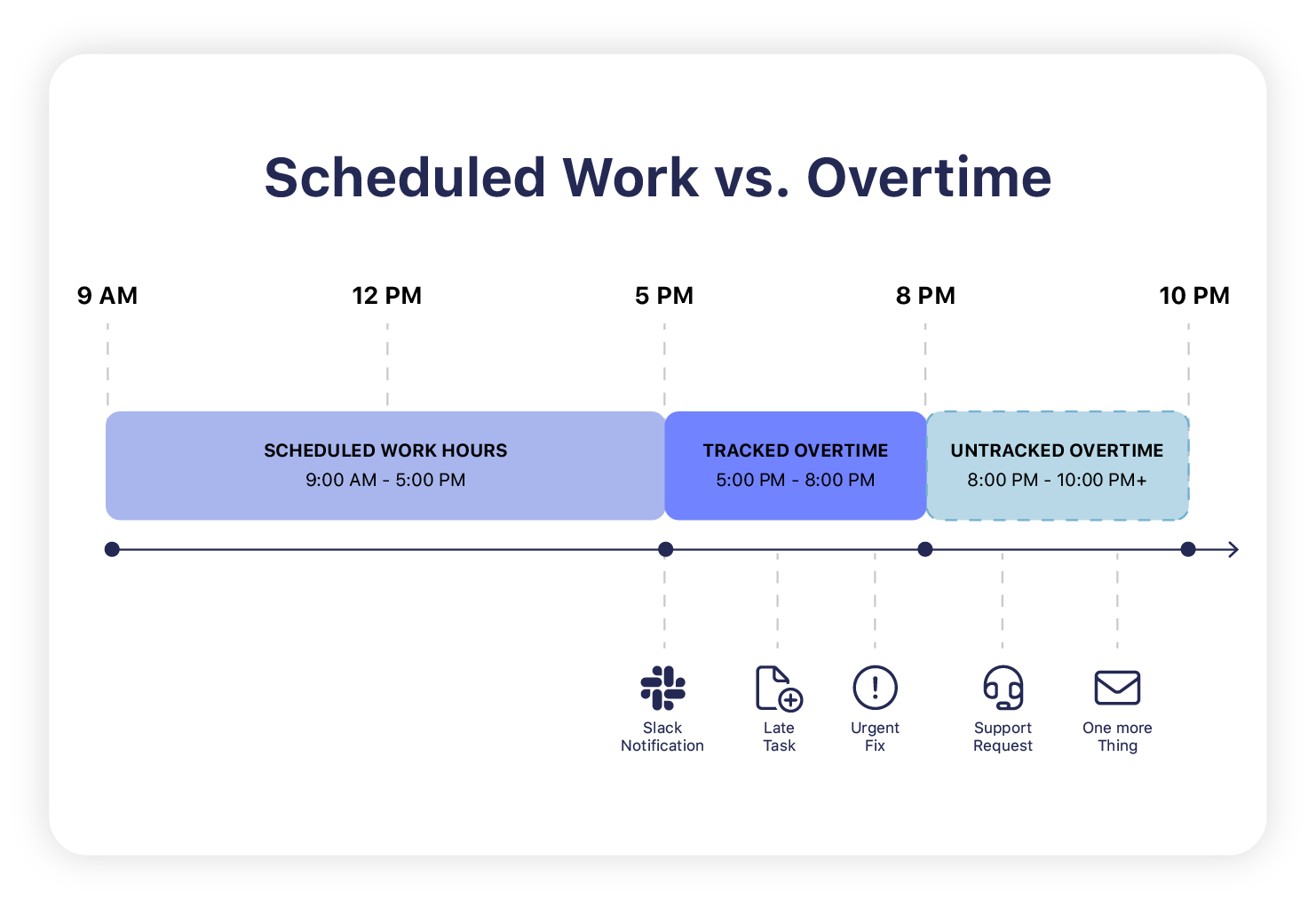
The distinction between regular hours and overtime matters because regular hours support predictable scheduling, while overtime can affect workload balance, project costs, and fairness across the team.
How extended work hours are calculated
In most companies, overtime is calculated by comparing total hours worked against scheduled hours over a given period, such as a day or a week.
⏱️ A simple example:
- Weekly overtime: An employee scheduled for 40 hours works 43 hours in a given week. The first 40 hours are regular time. The remaining 3 hours are overtime.
- Daily overtime: The same logic can apply daily. If a standard workday is 8 hours and an employee works 10, those 2 extra hours count as overtime for that day.
Extended work time should always be measured in relation to standard work hours. To better understand how work hours are defined, see our full guide on working hours.
Overtime calculator
Overtime Hours = Actual Hours Worked − Scheduled Hours
Enter scheduled and actual hours above to calculate overtime.
When Does Overtime Occur?
Overtime usually occurs when workload, timing, or unexpected demands exceed the team’s available capacity.
In practice, overtime tends to follow three common patterns:
Predictable overtime
This type of overtime is expected and planned. It typically happens during periods of increased demand, such as project deadlines, seasonal peaks, campaign launches, or when additional coverage is needed. Because it is anticipated, it can usually be managed and distributed across the team.
Reactive overtime
Reactive overtime happens when unexpected situations require immediate extra work. This can include urgent issues, last-minute requests, rework, understaffing, or gaps in scheduling. It is harder to plan for and can quickly disrupt workload balance if it becomes frequent.
Hidden overtime
Hidden overtime occurs when extra work is done outside regular hours but is not clearly tracked or acknowledged. This can include answering messages after hours, finishing tasks at night, or extending the workday without logging the time.
Hidden overtime is the hardest type to address precisely because it lacks visibility. Without a time tracking system in place, there is no way to know it is happening until it has already become a pattern.
Common Examples of Overtime (Real-world Scenarios)
Extra work time can manifest in different ways depending on the type of work, team structure, and workload. Here are some realistic examples:
- Employee staying late to meet a deadline
A designer is scheduled to finish at 5 pm., but a client presentation is due the next morning. They stay until 8 p.m. to finish the final slides, review feedback, and export the files. - IT support team handling after-hours requests
The IT support team ends its workday at 6 pm., but a key client reports a login issue at 5:50 p.m. One team member stays online to troubleshoot the problem and document the case. - Agency team during a campaign launch
A marketing agency is launching a paid campaign on Monday morning. On Sunday evening, the account manager and performance specialist spend extra time checking ad copy, budgets, tracking links, and landing page settings. - Hourly worker covering an extra shift
A retail employee is scheduled for a six-hour shift, but a coworker calls in sick. The manager asks them to stay three extra hours to keep the store covered during the busiest part of the day. - Remote worker extending the workday
A remote employee plans to finish at 5 p.m., but keeps answering Slack messages, making small edits, and updating tasks after hours.
📊 Industry Insight
A recent study from the ADP Research Institute (2025) reveals that the IT, Finance, and Utilities industries see the highest overtime rates, with 45% to 48% of their workforce regularly working beyond contractual hours.
These examples show that overtime is not limited to a single role or industry. It can happen in any team when work extends beyond the original plan.
What Is Overtime Pay?
The term overtime often also refers to the compensation employees receive for working extra hours. In many cases, extra work time is paid differently than standard hours, often at a higher rate or with additional compensation.
How overtime pay works depends on the organization and the type of role. Some companies apply higher hourly rates for extra hours, while others may offer time off in exchange or include extra hours as part of broader compensation structures.
Overtime pay is usually calculated separately from regular pay because extra hours are treated differently from standard scheduled work. The goal is usually to recognize additional workload and compensate employees fairly for time worked beyond expectations.
Because policies vary, it’s important for teams to clearly define how overtime is recognized and compensated to ensure fairness and transparency.
💡 Tracking Overtime Supports Compliance Visibility
Learn how time tracking supports compliance processes and workforce accountability.
Common Issues with Extra Work Time
For most companies, time worked beyond schedule becomes a problem when it is not clearly planned, tracked, or managed. Extra hours may help teams handle urgent work in the short term, but frequent or invisible overtime can create bigger issues in the long run.
Common overtime issues include:
- Overload and burnout: recurring extra hours can make workloads unsustainable.
- Budget overruns: unplanned overtime can increase labor costs or project costs.
- Inequity across team members: some people may consistently absorb more extra work than others.
- Reduced planning accuracy: teams may underestimate how much time work actually requires.
- Weaker visibility into team capacity: managers may not see when the team is stretched too thin.
Why Tracking Extra Hours Matters for Teams
When overtime is not properly tracked, organizations are essentially making decisions about workload, staffing, and compensation based on incomplete information. They may assume work is staying within plan when it is not. They may compensate people unfairly without knowing it. And they may repeat the same planning mistakes because the data to correct them never existed.
Tracking overtime turns invisible work into visible data. It does not eliminate extra hours, but it makes them manageable, and it gives teams the information they need to understand whether overtime is occasional and acceptable, or recurring and unsustainable.
Accurate extra work time records also help organizations maintain internal compliance processes and reduce disputes around worked hours, scheduling expectations, and compensation practices.
Benefits of tracking extra work time
Key benefits of tracking additional work hours include:
- Accurate records of worked hours: ensures that all time spent working is properly captured and accounted for.
- Better visibility into workload imbalances: helps identify when certain team members or roles are consistently working more than expected.
- Prevention of unpaid or unnoticed overtime: reduces the risk of hidden extra work going unrecognized.
- Support for fair compensation practices: makes it easier to align pay or time-off policies with actual work performed.
- Improved planning and forecasting: gives teams a clearer picture of how long work really takes, leading to more realistic schedules.
Tracking extra hours is part of a broader approach to managing time and attendance across teams. Without it, organizations risk making decisions based on incomplete or inaccurate data.
⏱️ Explore How Teams Track Work Time and Attendance
Learn how organizations manage attendance, schedules, and workload visibility through better time tracking and attendance processes.
How to Manage and Reduce Extended Work Time
Managing overtime starts with understanding where and why extra hours are happening. While some additional hours are often unavoidable, consistent or untracked extra work can be reduced with better visibility and planning.
Here are practical ways to manage and reduce extended work time:
1. Set clear expectations for work hours
Define when the workday starts and ends, and make sure the team understands what is considered extra time.
2. Monitor actual vs planned time
Compare scheduled hours with actual hours worked to identify when and where extra hours occur.
3. Identify patterns
Look for recurring situations, such as repeated late work, peak periods, or specific roles that consistently exceed their hours.
4. Adjust workloads and staffing
Rebalance tasks, redistribute work across the team, or increase capacity when extra workload becomes frequent.
5. Use time tracking for visibility
Tracking work hours helps teams see how time is spent, making it easier to detect overtime early and take action before it becomes a larger issue.
Reducing untracked extra time is about improving how work is planned, distributed, and tracked across the team.
Extra Hours Are a Signal Worth Tracking
Overtime reflects how work actually happens beyond the original plan. It appears when time requirements exceed expectations, whether due to workload peaks, unexpected issues, or gaps in visibility. Understanding how overtime works helps teams make better decisions about workload, staffing, and planning.
When overtime is not tracked, it can lead to hidden workload, miscalculated hours, unfair compensation, recurring overload, and poor planning decisions. What looks like occasional extra work can quickly become a pattern if it is not visible.
Tracking additional hours helps teams turn extra time into actionable insight. It provides a clearer picture of capacity, improves planning accuracy, and supports more balanced and fair ways of working.
⏱️ Explore Time and Attendance
To see how organizations manage time, attendance, and workload more effectively, explore Time and Attendance.
Frequently Asked Questions about Overtime
What is the meaning of overtime?
Overtime is any time worked beyond an employee’s scheduled or expected hours. It happens when actual work time exceeds the originally planned time.
When does overtime usually happen?
Overtime typically occurs during deadlines, workload peaks, staffing gaps, or unexpected issues that require additional work beyond regular hours.
Is overtime always paid?
Not always. Overtime is often compensated differently than regular hours, but how it is paid depends on company policies and the type of role.
Why should overtime be tracked?
Tracking overtime helps ensure accurate records, prevent hidden extra work, support fair compensation, and improve workload planning.
How can teams reduce overtime?
Teams can reduce overtime by setting clear expectations, monitoring actual vs planned time, identifying recurring patterns, and adjusting workloads or staffing.
What is the difference between overtime and extra hours?
Overtime refers to time worked beyond scheduled hours, often with specific compensation. Extra hours is a broader term that may include any additional work, whether tracked or formally recognized or not.
Can overtime happen without being noticed?
Yes. Overtime can be hidden when employees work outside regular hours without tracking their time, making extra work harder to detect.
How can you tell if overtime is becoming a problem?
Overtime becomes a problem when it happens frequently, affects the same people, or leads to workload imbalance, fatigue, or missed planning targets.
What causes overtime in most teams?
Overtime is usually caused by high workload, tight deadlines, understaffing, poor planning, or lack of visibility into how time is actually spent.


