How to Manage Client Retainers: A Guide for Agencies

Client retainers are a great way for agencies to create predictable revenue, but they can become expensive when your team doesn’t know how work is being consumed. This guide provides a practical method to manage retainer accounts, track hours, spot risks of overruns, protect margins, and support renewal conversations with real data.
Keep retainers on track:

💡 Managing client retainers means planning, tracking, and reporting work delivered under a recurring agreement, so your agency can prevent overruns, protect margins, and support renewals with real data.
How to Manage Client Retainers for Agencies
- What Effective Retainer Management Actually Means
- Why Retainers Often Go Off Track
- The Main Types of Client Retainers: Fixed-Fee vs. Hourly Retainers
- How to Effectively Manage Client Retainers in 7 Steps
- 1. Define the Retainer Operating Rules
- 2. Translate the Retainer Into Trackable Work Categories
- 3. Set a Period Budget for Hours, Scope, or Value
- 4. Track Retainer Work as It Happens
- 5. Monitor Retainer Pace in Real Time
- 6. Act on Overrun or Underutilization Signals
- 7. Close the Period and Prepare the Renewal Conversation
- What Metrics Should Agencies Track for Active Retainers?
- How TrackingTime Helps Agencies Manage Client Retainers
- Retainer Benchmarks and Industry Signals Agencies Should Watch
- What data shows
- How to Give Clients Visibility Without Overloading Them
- Worked Example: Managing a Monthly Agency Retainer
- Common Client Retainer Management Agency Mistakes
- Manage Retainers With Better Visibility
What Effective Retainer Management Actually Means
Effective retainer management is the process of managing the work, time, scope, communication, reporting, and renewal data tied to a recurring client agreement.
A good management process determines whether the agreement stays profitable for the agency and valuable for the client. Without a consistent workflow, retainers can become difficult to control: hours get consumed without visibility, client requests expand beyond scope, and renewal conversations are not supported by real data.
The key to ensuring a smooth retainer management process is to define the operating rules, track the work, monitor consumption, act on risks, report progress, and use data to support renewals. When that workflow is clear, the agency can protect margins and give the client a clear view of the value delivered.
According to the “State of Digital Agencies Survey” by SparkToro, 85% of agencies prefer to work with clients on a retainer basis.
Why Retainers Often Go Off Track
Client retainers often fail operationally because agencies don’t have enough visibility into how working hours are being used by the team.
So, by the time the team reviews the retainer, the overrun has already happened, or the agency may not have the hard data to support a renewal conversation.
Most retainer issues come from three visibility problems.
The Three Visibility Problems Behind Retainer Risk
| Visibility Problem | What Happens | What the Agency Needs to Know |
|---|---|---|
| Overrun risk | The team consumes more hours than expected and notices too late. | How much of the retainer has been used, what is driving the overrun, and whether the work is in scope. |
| Underutilization risk | The client does not see enough value during the period. | How much capacity remains, what useful work can still be prioritized, and whether client blockers are delaying progress. |
| Renewal blindness | The agency reaches renewal without clean data about what was delivered or how much time it took. | What was delivered, how the retainer was consumed, and whether the next period should be renewed, resized, or re-scoped. |
These problems can affect margin, client trust, and the agency’s ability to make informed decisions before the next period starts.
The Main Types of Client Retainers: Fixed-Fee vs. Hourly Retainers
The way an agency manages a retainer depends on how the agreement is structured. The two most common models are fixed-fee retainers and hourly retainers.
Fixed-Fee Retainer
In a fixed-fee retainer, the client pays a recurring fee for an agreed scope, service package, or ongoing relationship. The client may not be buying a specific number of hours, but the agency still needs to monitor how much time and effort the work actually requires.
For agencies, the main risk is delivery effort quietly increasing. Extra meetings, revisions, urgent requests, and senior team involvement can reduce the effective hourly rate and weaken the margin.
- To avoid this risk, agencies should track:
- Internal hours
- Cost by role
- Recurring work vs. ad hoc requests
- Scope changes
- Effective hourly rate
- Margin impact
According to SparkToro’s “State of Digital Agencies Survey“, 86% of agencies average monthly retainer is up to $10k.
Hourly Retainer
In an hourly retainer, the client buys a block of hours for a specific period. For example: 40 hours per month. The agency needs to manage how those hours are consumed, how much capacity remains, and what happens when the block is nearing capacity.
For agencies, the main risk is discovering too late that the team has already exceeded the agreed block or that the client has not used enough of the retainer to see clear value from the relationship.
To avoid this risk, agencies should track:
- Rollover rules, if applicable
- Hours used
- Hours remaining
- Approved overages
- Out-of-scope requests
👉 Agency Tip
Rollover rules should always be agreed with the client. The agency should document whether unused time expires, rolls over, or is handled manually in the next period.
How to Effectively Manage Client Retainers in 7 Steps
Managing a client retainer requires a practical workflow that helps the team understand what is included in the agreement, track work as it happens, monitor how the retainer is being consumed, communicate progress, and use data to make better decisions before the next cycle begins.
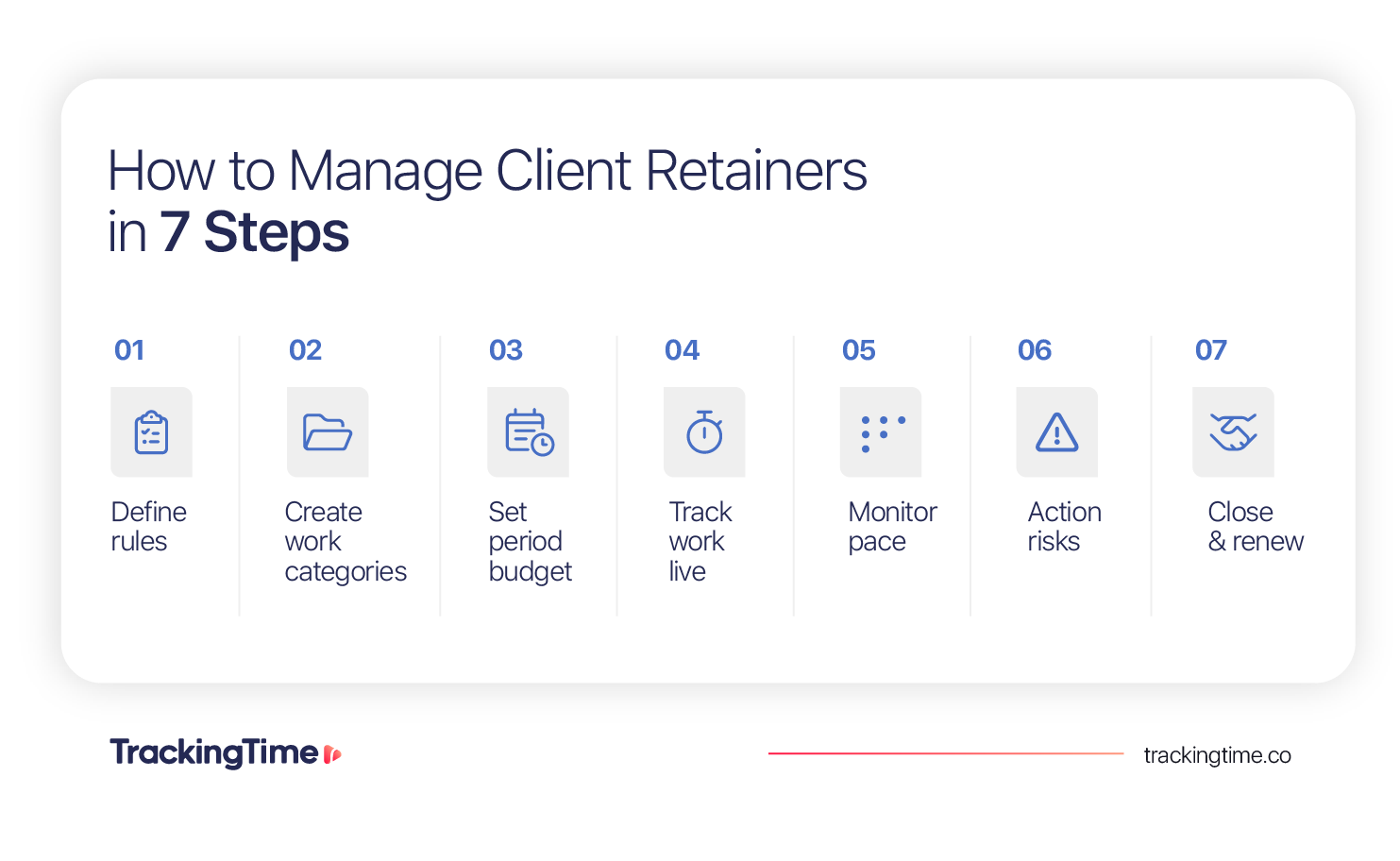
The following steps show how to manage client retainers.
1. Define the Retainer Operating Rules
Start by translating the retainer agreement into clear rules for the team. This matters because a retainer cannot be managed consistently if the team does not know what actually counts as included work.
If rules are unclear, every new request can feel urgent, every meeting can become “part of the service,” and extra work can accumulate without anyone noticing the impact on hours, scope, or margin.
Your internal retainer rules should define:
📌 Scope: services included, services excluded, and revision limits.
⏱️ Budget: monthly hour block or internal budget, overage rules, and rollover rules.
🔁 Workflow: response time expectations, meeting cadence, and approval process.
✅ Ownership: who can approve extra work before the team starts.
2. Translate the Retainer Into Trackable Work Categories
The next step is translating the retainer into work categories that the team can actually track. What you mainly want to avoid is recording work under generic labels like “client work” or “project support.”
A better approach is to break the retainer into categories that reflect the way the work is delivered. Common categories include:
- Project management
- Client communication
- Design
- Development
- Content
- Reporting
- QA
- Revisions
- Out-of-scope requests
These categories help the agency understand how the retainer is being used and what the total working hours distribution looks like.
📖 Recommended reading:
If you need a practical method for deciding what counts as billable work, read our recent guide on how to track billable hours and support client retainer billing.
3. Set a Period Budget for Hours, Scope, or Value
A key part of managing agency retainers is defining a period budget. This helps the agency compare what was planned with what is actually happening during the retainer period.
The period budget defines what the team delivers, how much effort it requires, and what the limits are. This is what gives account managers and project leads a baseline for spotting overuse, underuse, scope changes, or margin pressure.
💡 Agency Tip
Not all retainer work has the same strategic value. When hours are limited, prioritize work that protects the client relationship, removes blockers, or supports measurable outcomes over low-impact requests that simply consume time.
Fixed-fee retainers
For fixed-fee retainers, agencies need an internal hour budget. For example, for a $6,000 monthly retainer, the agency may decide that the work should stay under 40 hours to remain profitable. If the team regularly spends 50 to 60 hours, the retainer is losing margin.
Hourly retainers
In hourly retainer contracts, the period budget should make clear how many hours are included, what happens when the block is consumed, and whether unused hours expire, roll over, or require manual agreement. For example, if a client buys 40 hours per month, the team needs to know when to flag extra work, who approves overages, and how remaining hours should be communicated before the period closes.
4. Track Retainer Work as It Happens
To effectively manage retainer accounts, agencies need to track working hours in real time, not at the end of the month. If the team reconstructs hours after the work is done, the agency loses the ability to act while there is still time.
Retainer data needs context so the agency can review scope, explain value to the client, and support renewal conversations with a clear record of what happened during the period.
Example of a Weak Time Entry
Client work — 4 hours
Example of a Useful Time Entry
👤 Client: SaaS Bridge
🔁 Retainer period: May 2026
📁 Project: Monthly SEO retainer
🏷️ Task: Technical SEO fixes
👥 Role: SEO specialist
⚙️ Work category: Technical SEO
⏱️ Time spent: 2.5 hours
📝 Notes: Updated redirects, fixed metadata issues, and added internal links.
✅ Billable status: Included in retainer
An agency that manages multiple clients and team members usually needs a time-tracking system that keeps retainer data up to date while work is underway.
5. Monitor Retainer Pace in Real Time
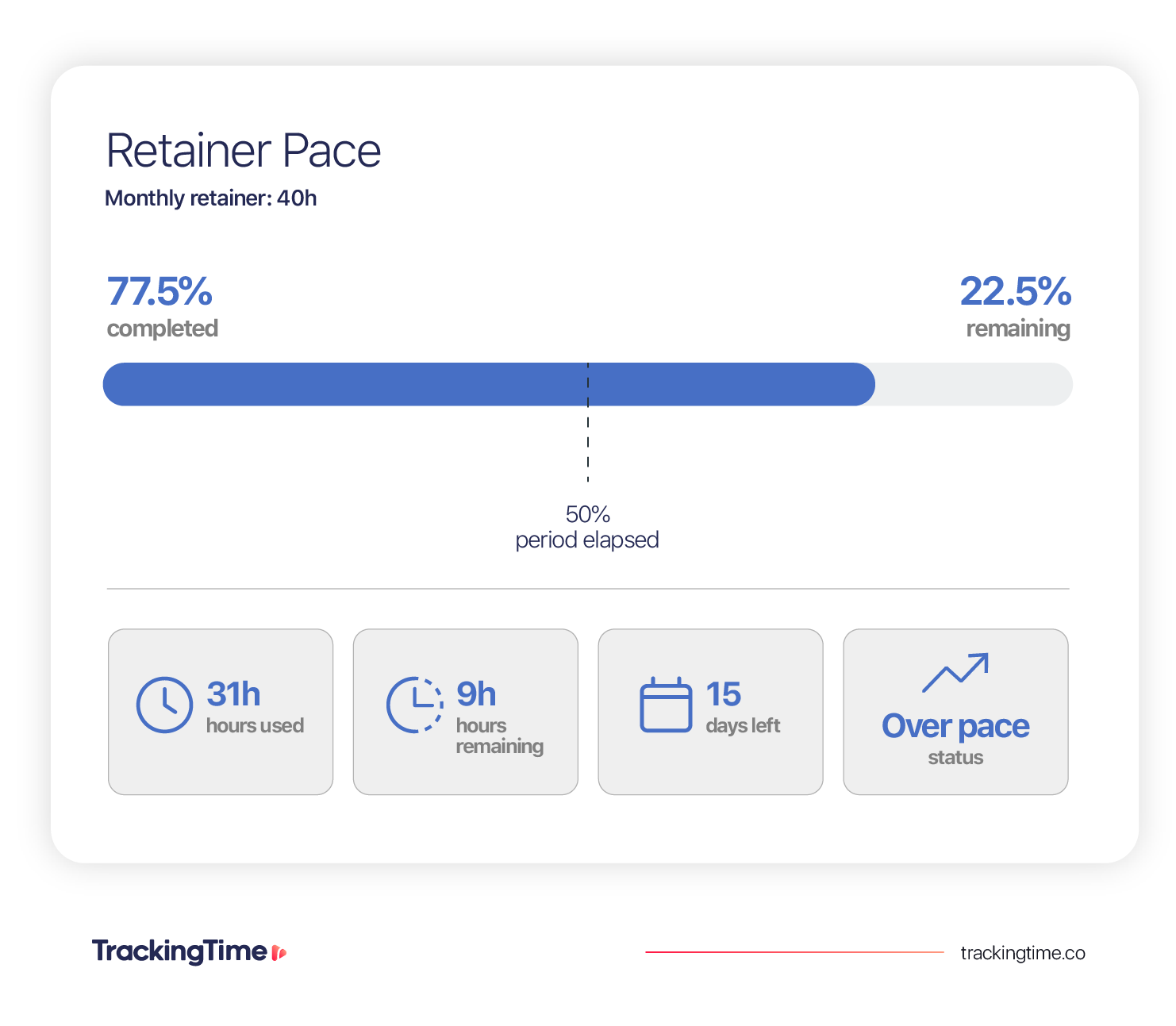
Retainer pace shows whether the retainer is being consumed at a sustainable rate compared with the time left in the period. It helps the agency see whether the team is on track, ahead of pace, or underusing the retainer.
For example, if a monthly retainer includes 40 hours and the team has already used 31 hours by the 15th day of the month, the retainer is ahead of pace and may be at risk of overrun.
On the contrary, if the team has used only 8 hours near the end of the month, the retainer is being underutilized, and the client may not see enough value from the period.
Calculate retainer consumption
Use this formula to calculate retainer consumption and compare consumption against how much of the period has passed:
Retainer consumption rate = hours used ÷ hours included × 100
Period elapsed = days passed ÷ total days in period × 100
Period
Fill in the fields above to see your retainer consumption rate.
6. Act on Overrun or Underutilization Signals
Once retainer pace shows that the work is moving too fast or too slowly, the agency should decide what to change before the period closes.
If the retainer is over pace
If the retainer is over pace, the goal is to protect margin and avoid overages.
This is what you can do:
- Identify which category is consuming the most time
- Check whether that work is included in scope.
- Pause lower-priority requests
- Move non-urgent work to the next period
- Request approval before extra work continues
- Adjust the staffing or role mix
- Inform the client before the limit is reached.
The reason for the overrun should also be documented so it can be discussed during the next review or renewal conversation.
💡 Scope Control
A small request can still create a large delivery cost if it triggers meetings, revisions, QA, or senior review. Before accepting “quick” requests, consider the total workflow they create for the team.
If retainer is underused
If the retainer is underused, the goal is to protect perceived value and make sure the client understands what is happening.
This is what you can do:
- Check what is blocking the work (client delays, missing approvals, unclear priorities)
- Identify useful work that can still be prioritized before the period closes
- Communicate what has been completed and what remains
- Review whether the retainer is oversized if the same pattern repeats.
7. Close the Period and Prepare the Renewal Conversation
Finally, at the end of the retainer period, close the cycle with clean data. This creates a reliable record of what was delivered, how much time was used, what affected delivery, and what should change in the next period.
A period closeout should review:
- Hours included in the agreement
- Hours used
- Hours remaining or exceeded
- Work completed
- Out-of-scope requests
- Approved overages
- Client blockers
- Client-visible summary
- Recommendations for the next period
This review helps the agency explain to the client why the retainer was used the way it was and what adjustments would make the next period more effective.
Any renewal conversation should start from documented consumption and delivered value. When the agency can show how the retainer was used, what work created value, and where scope or demand changed, it becomes easier to justify the next recommendation.
What Metrics Should Agencies Track for Active Retainers?
Agencies need a clear set of operational metrics that show how the retainer is being consumed, where the work is going, and what should be reviewed before the period closes.
Use the table below to audit your current retainer management process:
| Metric | What It Shows | Why It Matters |
|---|---|---|
| Hours included | Contracted or internal period budget | Sets the working limit for the retainer period. |
| Hours used | Actual consumption | Shows how much of the retainer has already been used. |
| Hours remaining | Available capacity | Helps the team prioritize work before the period closes. |
| Consumption rate | Percentage of the retainer used | Shows whether the retainer is at risk of overrun or underutilization. |
| Period elapsed | Percentage of the period completed | Adds pace context so consumption can be compared with time remaining. |
| Work by category | Where time is going | Reveals scope creep, service imbalance, or unexpected delivery patterns. |
| Out-of-scope work | Requests outside the agreement | Supports client conversations about added work, approvals, or separate projects. |
| Approved vs. unapproved time | Governance status | Keeps the period close clean and prevents disputed work from reaching the invoice or report. |
| Effective hourly rate | Fee divided by actual hours | Helps evaluate whether a fixed-fee retainer is still profitable. |
| Historical usage | Trends by period | Supports renewal, resizing, and scope decisions with real data. |
These metrics are most useful when they are reviewed during the period, not only after it ends.
How TrackingTime Helps Agencies Manage Client Retainers
TrackingTime helps agencies structure retainer work, track time consistently, review team activity, and share reports with clients without relying on manual end-of-month reconstruction.
What You Can Do With TrackingTime
Agencies can use TrackingTime to manage client accounts on retainer by tracking work across clients, projects, tasks, and team members. This gives account managers and project leads a clearer view of where time is going, which work is billable or non-billable, and how team activity connects to each client relationship.
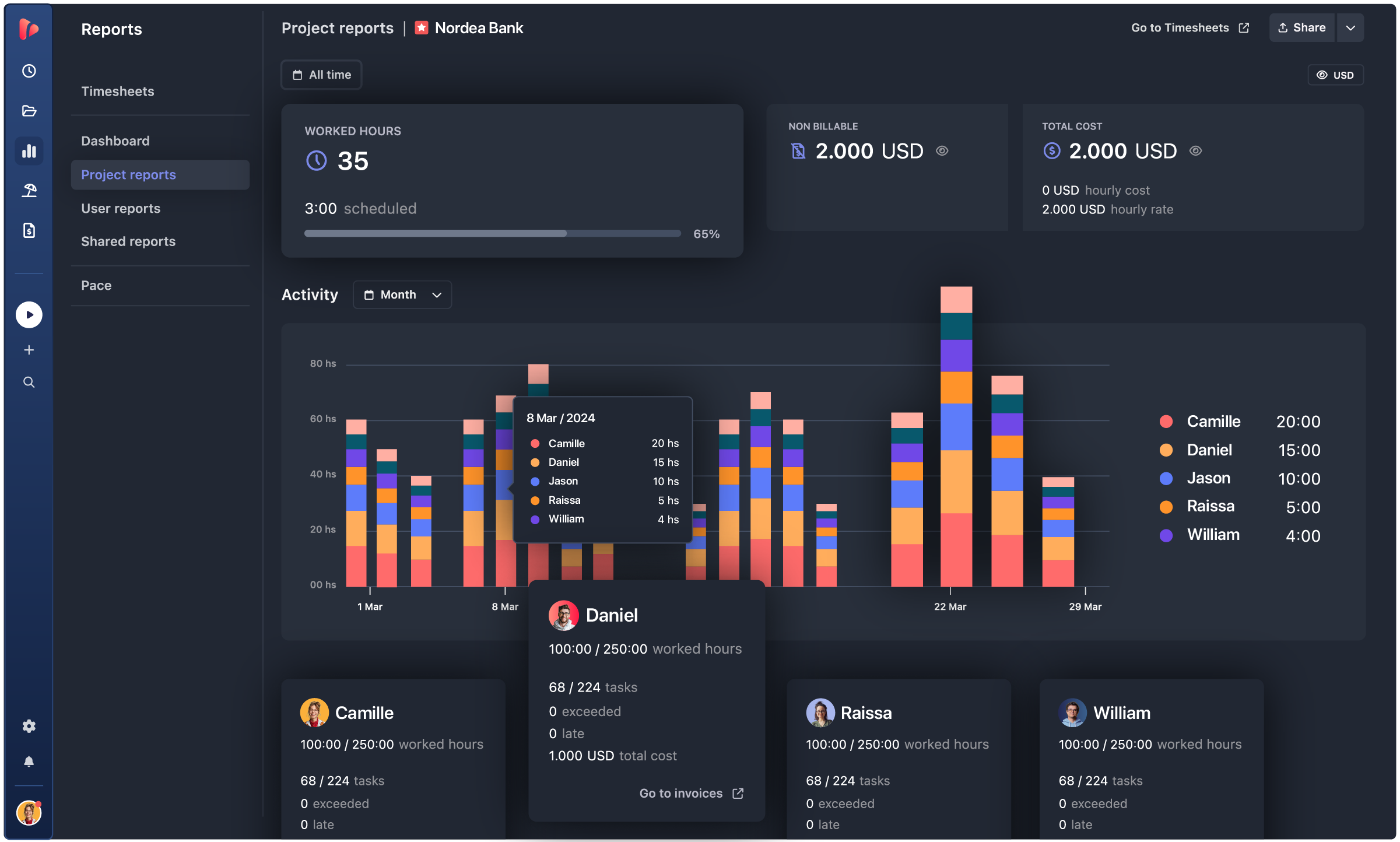
TrackingTime includes:
- Unlimited projects, clients, and tasks with no usage fees
- Client retainer billing
- Timesheet Approvals to review time before closing a period
- Invoicing with billable rates, task rates, historical user costs, and profitability reporting
- Shared Reports for client visibility without giving full workspace access
- Unlimited read-only access for clients and stakeholders, no paid seat required
- Project management with task lists, boards, and timelines, so you don’t need a second tool
- PTO, holidays, and time cards
This helps agencies move to a more structured retainer workflow, where teams can review activity, prepare cleaner reports, and keep client conversations grounded in actual work data.
TrackingTime’s Pro Plan is priced at $5.75 per seat per month, billed annually.
🏆 The best option for Agencies
TrackingTime‘s monthly cost doesn’t change based on how many projects you run, clients you bill, or invoices you send. Trusted by 15,000+ teams. Rated 4.7/5 on G2.
Coming Summer 2026: Retainer Tracking
TrackingTime’s Pro Plus plan, coming in Summer 2026, includes dedicated Project Retainers functionality specifically designed for agencies. This feature helps teams manage blocks of hours or budgets, monitor consumption in real time, and understand whether each account is on pace before the period closes.
With TrackingTime Pro Plus, agencies can:
- Define a retainer by client and project
- Monitor consumed vs. remaining hours
- Use pace dashboard by client
- Get automatic overrun risk warnings
- Get unlimited Client Users so clients can log in and see their own project data
- Review historical consumption by period
- Support renewal conversations with actual usage data
- Share retainer visibility with clients
- Connect retainer tracking with approvals, expenses, reporting, and invoicing workflows
For agencies, this means retainer management becomes less reactive. The team can see consumption earlier, act on risks sooner, and prepare renewal conversations with a clear history of how the retainer was used.
TrackingTime Pro Plus is priced at $7.50 per seat per month when billed annually, with no usage fees.
📊 Manage retainer accounts with better visibility
Use TrackingTime to track retainer work, review consumption, share client-friendly reports, and support renewal decisions with real data.
Retainer Benchmarks and Industry Signals Agencies Should Watch
The vast majority of agencies today prefer to work on a retainer basis. The reason is clear: retainer-based work provides a recurring stream of revenue and can improve revenue predictability, but only when agencies can control scope, monitor delivery effort, and show clients what is being delivered during each period.
Recent agency benchmarks point to four signals agencies should keep in mind when managing retainer agreements:
| Benchmark / Signal | Sources |
|---|---|
| Many agency retainers are relatively small monthly accounts. | SparkToro reported that 86% of agencies said their average monthly retainer is up to $10k. |
| The vast majority of agencies prefer to work with clients on a retainer contract model. | According to SparkToro, 85% of agencies prefer to work with clients on a retainer basis. |
| Digital agency margins are often not very large. | Promethean Research reported that digital agencies averaged 13% after-tax net margins in 2025, with a practical benchmark range of 10% to 20%. |
| Time tracking is essential even for fixed-fee retainers. | Sidekick Accounting notes that agencies still need to track time on fixed-fee retainers to know whether they are profitable. |
Retainer-based client relationships work best when agencies can connect revenue, delivery effort, and scope in the same review process. A strong retainer workflow should show hours planned vs. hours used, effective hourly rate, work by category, out-of-scope requests, client blockers, and renewal patterns.
What data shows
Patterns from time tracking data across agency retainer accounts point to a few consistent trends:
- Retainer overruns happen earlier than expected. The majority of retainers that exceed their hour budget do so before the final week of the period, meaning teams that review pace only at month-end are already too late to act.
- Communication and meetings are the most underestimated category. Client calls, internal syncs, and status updates regularly account for 20–30% of total retainer hours, yet most agencies do not track them as a distinct work category.
- The gap between estimated and tracked hours grows with retainer size. Smaller retainers (under 20 hours/month) tend to be consumed more predictably. Larger retainers show wider variance between what was planned and what was actually used.
- Fixed-fee retainers carry hidden hour pressure. Agencies running fixed-fee agreements tend to spend more hours per dollar of retainer revenue than hourly retainers, largely because scope boundaries are less explicit and requests accumulate without a visible counter.
How to Give Clients Visibility Without Overloading Them
Clients do not need access to every internal task or workspace detail. But they do need enough visibility to understand what was done, how the retainer was used, what is still in progress, and which decisions are needed from their side.
A client retainer report needs to be clear, simple, and focused on value. In this sense, agencies should summarize the information that helps the client understand progress, consumption, and next steps.
A useful retainer report should include:
- Retainer period
- Hours included
- Hours used
- Hours remaining
- Key work completed
- Work in progress
- Upcoming priorities
- Pending decisions
- Out-of-scope requests
- Approved overages
- Recommended next steps
This kind of visibility reduces invoice friction and supports renewal conversations because the client sees value throughout the period.
💡 Client Communication Tip
Use retainer updates to shape priorities, not just report activity. A good update should help the client decide what to approve, delay, remove, or move into a separate project.
Worked Example: Managing a Monthly Agency Retainer
This example shows how an agency can track retainer pace, identify overrun risk, act before the period closes, and use the data to support a renewal conversation.
The Agency
Northline Studio is a 22-person digital agency that manages marketing and website support for B2B SaaS clients.
Retainer Details
| Retainer Detail | Example |
|---|---|
| Monthly fee | $6,000 |
| Included hours | 40 hours |
| Period | Monthly |
| Services included | Content updates, landing page support, reporting, campaign support |
| Main risk | Client requests often increase after campaign launches |
The retainer works well during regular months. But when the client launches a campaign, requests for landing page revisions, reporting updates, and extra campaign support often increase.
Mid-Month Review
Halfway through the month, the project manager reviews retainer pace.
| Metric | Status |
|---|---|
| Period elapsed | 50% |
| Hours used | 31 of 40 |
| Retainer consumed | 77.5% |
| Hours remaining | 9 |
| Main issue | Landing page revisions and ad hoc campaign requests consumed more hours than planned. |
Review shows that the retainer is ahead of pace. Half of the period has passed, but more than ¾ of the hours have already been used. If the team continues at the same rate, the account will exceed the 40-hour block before the month closes.
Actions Taken
Instead of waiting until the invoice or end-of-month report, the project manager does the following:
- Identifies revisions and campaign support as the main drivers of extra time
- Pauses low-priority requests until the next period
- Informs the client that the retainer is being consumed faster than expected
- Requests approval before continuing with extra campaign work
- Gets approval for 8 additional hours
- Documents the pattern for the next renewal conversation
Takeaways
This example shows why retainer visibility matters during the period. Key lessons for agencies:
- Review retainer pace before the period closes.
- Compare hours used with both the hour block and the time elapsed.
- Look at which work categories are driving consumption.
- Flag overrun risk before extra work continues.
- Get approval for additional hours before the retainer limit is reached.
- Use repeated patterns to adjust the next renewal.
In this case, the agency used real usage data to recommend a higher monthly block for campaign-heavy months.
Common Client Retainer Management Agency Mistakes
Most retainer problems come from operational gaps: unclear scope, weak time tracking, late reviews, poor client visibility, or renewal conversations that are not supported by data.
Mistakes That Create Overruns
These mistakes cause the agency to consume more time than expected without noticing the margin impact early enough:
- Treating every client request as included
- Tracking all retainer work in one generic bucket
- Not tracking internal meetings or client communication
- Waiting until the end of the month to review hours
- Failing to separate recurring work from new project work
- Using senior team members for too much execution work
Mistakes That Weaken Client Trust
These mistakes make it harder for the client to understand what is happening during the retainer period:
- Giving clients no visibility until the invoice
- Reporting only hours, not outcomes
- Surprising the client with overages
- Failing to document out-of-scope work
- Letting unused hours become invisible
Mistakes That Hurt Renewals
These mistakes make renewal conversations vague, reactive, or based on perception instead of evidence:
- Renewing based on memory instead of data
- Not reviewing historical usage
- Not adjusting scope when patterns repeat
- Treating every retainer the same
Manage Retainers With Better Visibility
A client retainer is only predictable if the agency can manage it while the work is happening, not after the period has already closed. The best retainer management agency process gives agencies visibility into hours, scope, consumption, pace, client communication, and renewal data before it is too late to act.
Spreadsheets may work for a small number of retainers, but they become harder to maintain as the agency manages more clients, team members, tasks, approvals, reporting needs, and renewal conversations. At that point, the team requires a workflow that helps them spot risks, keep clients informed, and make better decisions for the next period.
🏆 Try TrackingTime’s Project Retainers Software
Be among the first to try dedicated Project Retainers in TrackingTime, coming in Summer 2026. Track retainer consumption, spot overrun risks early, and manage client retainers with better visibility from period start to renewal.
Frequently Asked Questions about Client Retainer Management
What is client retainer management?
Client retainer management is the process of planning, tracking, reviewing, and reporting the work delivered under a recurring client agreement. It helps agencies monitor hours, scope, progress, and renewal data while the retainer period is still active.
How do you manage client retainers effectively?
To manage client retainers effectively, define what is included, create work categories, set a period budget, track work live, monitor retainer pace, act on risks early, and close each period with clean data for renewal decisions.
How do agencies track retainer hours?
Agencies usually track retainer hours with a time tracking sofware, logging time against the correct project, task, work category, and retainer period. Each entry should show what work was done, how much time it used, and whether it was included, approved, or out of scope.
What is retainer pace?
Retainer pace shows whether a retainer is being consumed at a sustainable rate compared with the time left in the period. Agencies use it to identify whether a client account is on track, over pace, or underused before the period closes.
What should be included in a client retainer report?
A client retainer report should include the retainer period, hours included, hours used, hours remaining, completed work, work in progress, upcoming priorities, pending decisions, out-of-scope requests, approved overages, and recommended next steps.
What happens if a client uses more hours than included?
If a client uses more hours than included, the agency should pause and review scope, identify what caused the overrun, request approval before extra work continues, document the overage, and use the data to adjust the next retainer period.
What happens if a client does not use all retainer hours?
If a client does not use all retainer hours, the agency should check for blockers, unclear priorities, or delayed approvals. Depending on the agreement, unused hours may expire, roll over, or be reviewed during the next planning or renewal conversation.
What is retainer tracking software?
Retainer tracking software helps agencies monitor retainer hours, budgets, work categories, approvals, reports, and period usage in one place. It gives teams visibility into consumed and remaining time so they can spot overrun or underutilization risks earlier.


