What Is Paid Time Off? How It Works, Examples, and Policy Template

Paid time off (PTO) is a workplace policy that allows employees to take paid leave for vacation, illness, or personal reasons. In simple terms, paid time off refers to the total number of days or hours employees can take off while still getting paid.
👉 Paid time off means:
- Paid leave from work
- Includes vacation, sick leave, and personal time
- Given as days or hours per year
- Can be accrued or assigned upfront
Paid time off Meaning & How It Works
- What is Considered Paid Time Off ?
- Paid time off vs Vacation vs Sick Leave
- How Paid Time Off Works
- Common PTO Policy Structures
- Benefits of Paid Time Off for Employees and Companies
- Potential Drawbacks of Paid Leave Policies
- Example PTO Policy Structure (Template)
- What Paid Time Off Means for Employees and Companies
What is Considered Paid Time Off ?
In practice, paid time off is included in employment contracts and workplace policies as a defined benefit, usually expressed as a number of days or hours available per year. PTO policies typically outline how time is earned, when it can be used, and whether unused time carries over, making paid time off both an employee benefit and a practical planning tool for organizations.
On a day-to-day level, employees interact with paid time off by checking their available balance, submitting time-off requests, and coordinating with managers to ensure coverage.
Depending on how a company structures its policy, paid time off can include different types of leave. These are the most common ones:
| Type of Leave | What It Covers | Included in PTO? |
|---|---|---|
| Vacation time | Planned time off for rest, travel, or personal use | Usually yes |
| Sick leave | Time off due to illness or medical appointments | Often included |
| Personal days | Short-notice or personal obligations | Usually yes |
| Family or emergency leave | Caring for family members or urgent situations | Sometimes |
| Public holidays | Company or government-designated holidays | Usually separate |
The exact categories included in paid time off vary by company. Some organizations combine all leave into one PTO bank, while others keep certain types of leave (such as public holidays or extended medical leave) separate.
💡 Paid time off reflects company priorities: The structure of a PTO policy often says as much about company culture as it does about leave management.
Paid time off vs Vacation vs Sick Leave
Although paid time off, vacation, and sick leave are often used interchangeably, they do not always mean the same thing.
In many companies, paid time off combines different types of leave into one system. However, in more traditional leave policies, vacation time and sick leave are tracked as separate categories with different rules and purposes.
PTO combines all leave into one balance, while traditional policies separate vacation and sick leave into different categories:
| Leave Type | How It Works | Flexibility | Typical Use Cases |
|---|---|---|---|
| Paid time off (combined) | All leave is grouped into one balance that employees can use as needed | High | Vacation, illness, personal time |
| Vacation time | Separate days specifically allocated for planned time off | Medium | Travel, rest, planned breaks |
| Sick leave | Separate days reserved for illness or medical needs | Low (restricted) | Illness, doctor appointments |
Key differences
- Paid time off combines multiple leave types into one balance
- Vacation and sick leave are usually tracked separately
- Paid time off offers more flexibility, while separate policies provide clearer boundaries
How Paid Time Off Works
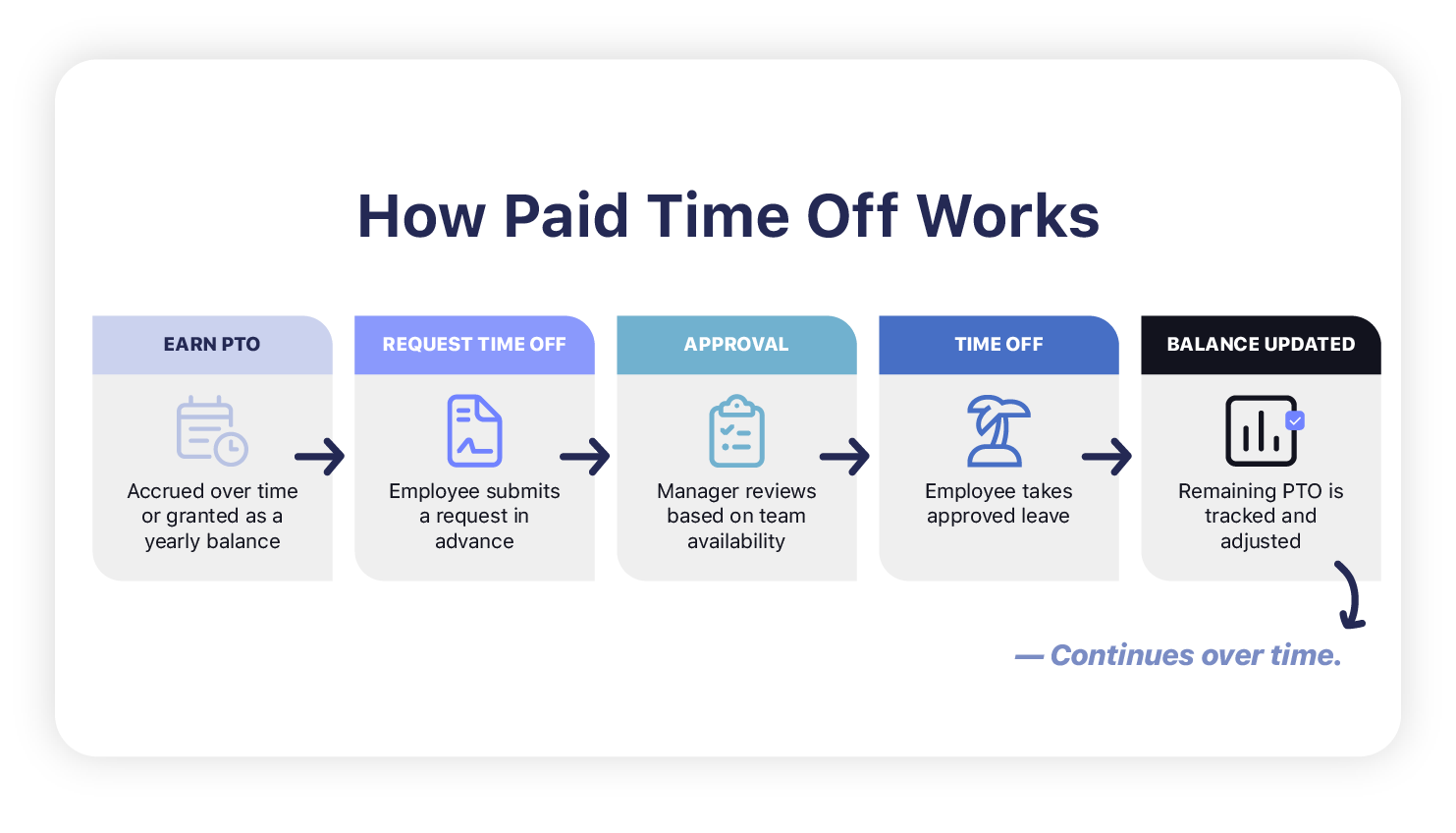
Paid time off works through a set of rules that determine how employees earn paid leave, when they can use it, and how employers track paid time off overtime.
While the exact structure varies by company, most PTO policies follow a similar system that gives employees flexibility while helping teams plan coverage.
1. Accrual vs. lump sum
In some companies, employees earn paid time off gradually based on time worked, such as a set number of hours per month or per pay period. In others, employees receive a fixed amount of leave entitlement at the beginning of the year, which they can use as needed.
2. Carryover and expiration rules
Companies often define how much unused paid time off can be carried over into the next year. Some allow partial rollover, while others require employees to use their time off within a specific period or risk losing it.
3. Request and approval process
To use paid time off, employees typically submit a request in advance, which managers review based on team availability and workload. This helps ensure that time off does not disrupt operations or create coverage gaps.
4. Tracking and balances
Companies track paid time off internally, so employees can see how much time they have available and how much they have used. This visibility helps teams plan ahead and maintain a clear overview of availability across the organization.
💡 Example:
An employee receives 20 days of paid time off per year.
- 10 days used for vacation
- 5 days for illness
- 5 days for personal time
Instead of separate categories, all time comes from the same PTO balance.
How Many PTO Days Do Employees Get?
Most companies offer between 10 and 25 days of paid time off per year, depending on role, seniority, and location. Some companies increase PTO with tenure or offer flexible policies like unlimited PTO.
Paid time off structures can vary significantly by company and location. For a broader perspective on how these policies differ across countries, see how companies approach global PTO policies.
Common PTO Policy Structures
Companies structure leave policy in different ways depending on their size, industry, and operational needs. While policies can vary, most companies use one of the following common approaches.
1. Accrued PTO
In this model, employees earn PTO gradually over time, usually based on hours worked, weeks, or months of service. This approach is common in companies that want to align time off with tenure and ensure availability is built progressively.
2. Lump-sum PTO (annual allocation)
Employees receive a fixed number of PTO days or hours at the beginning of the year. This model is often used in organizations that prioritize simplicity and want employees to have immediate access to their full leave balance.
3. Unlimited PTO
Instead of assigning a specific number of days, companies allow employees to take time off as needed, as long as it is approved and does not affect performance or team responsibilities. This approach is typically used in results-driven environments where flexibility and trust are emphasized.
👉 Unlimited PTO does not mean unlimited time off
In practice, usage is still shaped by team expectations, workload, and approval processes.
4. Separate leave vs. combined PTO bank
Some companies group all types of leave into a single paid leave balance, while others keep vacation, sick leave, and other categories separate. Combined systems offer more flexibility, while separate policies provide clearer guidelines on how each type of leave should be used.
Each structure reflects a different balance between flexibility, control, and administrative simplicity, and companies often choose the model that best fits their culture and operational requirements.
Benefits of Paid Time Off for Employees and Companies
Paid time off benefits both employees and companies when it is structured clearly and used consistently.
For employees
- Better work-life balance by making it easier to step away from work when needed
- More flexibility to use paid leave for vacation, illness, or personal matters
- Reduced burnout by encouraging rest and recovery through paid time away
For companies
- Simpler leave management by reducing the need to oversee multiple separate leave categories
- More predictable planning through clearer visibility into time-off balances and team availability
- Improved retention by offering a benefit that supports employee well-being and flexibility
💡 A clear PTO policy reduces internal friction.
When rules are well-defined, teams spend less time clarifying requests and more time planning work effectively.
Potential Drawbacks of Paid Leave Policies
While paid time off offers flexibility and simplicity, it can also present challenges depending on how policies are designed and managed. That’s why understanding these potential drawbacks helps organizations create clearer and more effective leave structures.
- Employees not using paid time off: In some cases, especially with unlimited PTO policies, employees may take less time off due to unclear expectations or workplace culture, leading to underuse of the benefit
- Lack of clarity in combined systems: When all leave types are grouped into a single PTO balance, employees may be unsure how to prioritize time off or whether certain situations (like illness) should be treated differently
- Planning difficulties for teams: Without clear guidelines or visibility, managing overlapping time-off requests can make it harder for teams to maintain coverage and meet deadlines
- Policy misuse or inconsistencies: If leave policy rules are not clearly defined or applied consistently, it can lead to misunderstandings, uneven usage across teams, or perceived unfairness
💡 How paid time off is used matters more than how much is offered: A generous policy has little impact if employees do not understand what the policy covers or are unsure when or how to request time off.
Example PTO Policy Structure (Template)
A PTO policy typically follows a structured format that defines how time off is earned, requested, and managed. While policies vary by company, most include the same core components.
Most PTO policies include:
- Policy overview: Explains what paid time off covers and how the policy is intended to work
- Eligibility: Specifies which employees qualify for paid time off and when it becomes available
- Accrual rules: Explains how paid time off is earned, whether monthly, annually, or based on hours worked
- Request and approval process: Outlines how employees request time off and how approvals are handled
- Carryover and expiration rules: Defines whether unused paid time off rolls over, expires, or is capped
- Exceptions or special cases: Covers situations such as extended leave, medical conditions, holidays, or legal requirements
If you need a practical starting point, use this PTO policy template to create or adapt your own internal policy 👇
Download the PTO policy template
What Paid Time Off Means for Employees and Companies
Paid time off gives companies a clear way to organize employee leave while giving employees paid time away from work for vacation, illness, and personal matters. At its core, PTO policies help organizations create a system that supports both employee flexibility and operational planning.
A clear PTO policy makes leave management more consistent and helps teams plan coverage more effectively. While paid time off structures can vary by company practices and local regulations, the core idea is to support both individual well-being and the day-to-day needs of the business.
For more information about how paid leave laws, vacation days, and holiday rules work in each country, explore our Global PTO database.
Frequently Asked Questions about Paid Time Off
What does PTO mean at work?
PTO means paid time off. It refers to a workplace policy that allows employees to take paid time away from work for vacation, illness, or personal needs, depending on how the company structures its leave policy.
Is paid time off the same as vacation time?
No, paid time off is not always the same as vacation time. Vacation time is usually one specific category of leave, while PTO often combines vacation, sick leave, and personal days into a single balance employees can use as needed.
How is paid time off calculated?
PTO is usually calculated based on time worked or length of service. Employees may earn a set number of hours per pay period or receive a fixed number of days per year, depending on the company’s policy.
Do unused PTO days expire?
Unused PTO days may expire, depending on the company policy. Some organizations allow employees to carry over unused PTO, while others set expiration rules or limits on how much time can be rolled over into the next period.
What is included in PTO?
PTO commonly includes vacation time, sick leave, and personal days. However, what is included can vary by company, and some types of leave, such as public holidays or parental leave, are often managed separately.
What is unlimited PTO and how does it work?
Unlimited PTO is a policy that allows employees to take time off without a fixed balance. In practice, time off still requires approval and must not negatively affect performance, responsibilities, or team coverage.
What is the difference between paid time off and leave?
PTO is a specific type of paid leave, while leave is a broader term for any time away from work. Leave can include paid or unpaid time off, as well as legally required absences handled separately from PTO.
How do companies track PTO?
Companies track PTO by recording accrual, usage, and remaining balances in internal systems or software. This helps maintain visibility over employee availability and supports accurate record-keeping.


