Morning Routine for Productivity: 10 Habits That Work

A productive morning routine does not require waking at 5 AM or following someone else’s script. It requires a small set of repeatable habits that convert your first hours into consistent workday performance, and the discipline to protect them.
👉 Quick summary
- The goal of a morning routine is to reduce decisions before noon, not add more tasks to your schedule.
- Night-before preparation is where your morning is actually built.
- Time management techniques work best when applied to your first three tasks, not your full day.
- Single-tasking in the first work block outperforms any multi-channel startup ritual.
- The transition from morning routine to desk work is where most productivity gains are lost.
- A checklist replaces willpower: you follow a system, not a mood.
Table of Contents
Why Most Morning Routines Break Down
Most morning routines fail not because people lack discipline, but because they are designed around aspiration rather than constraints. A routine that works in theory, wake at 6, meditate, exercise, journal, eat a balanced breakfast, tends to collapse against the reality of a full inbox, a school run, or a client call at 8:30.
The practical starting point is a simpler question: what is the minimum viable morning that still sets you up for a focused first work block? For most professionals, the answer comes down to three elements: a clear head, a defined task, and enough physical energy to execute.
Morning hours, when willpower and cortisol are both at natural peaks, are disproportionately valuable for cognitive work. The goal of a morning routine is to protect that window, not fill it with more obligations. When routines fail, it is almost always because they added complexity without removing friction.
The Core Habits of a Productive Morning Routine
Not every morning habit delivers equal value. The ones with the highest return tend to be short, repeatable, and connected directly to your work performance rather than abstract wellbeing goals.
Wake at a Consistent Time
Your circadian rhythm regulates alertness cycles, and inconsistent wake times disrupt them. Choosing a fixed wake time, including on weekends, stabilizes your sleep architecture and makes the morning feel less effortful over time. The specific hour matters less than the consistency.
Hydrate and Move Before Screens
The first 20 minutes after waking are best spent away from devices. Drinking water replenishes fluid lost overnight and supports cognitive function. Brief physical movement, whether a stretch routine, a short walk, or a 10-minute workout, raises cortisol to its natural peak and increases alertness measurably. Both habits require almost no time and have well-documented effects on focus and mood for the hours that follow.
Protect a Focused First Work Block
The most durable morning habit for professionals is committing one specific block of time, typically 60 to 90 minutes, to deep work before attending to messages or meetings. This is where your highest-value tasks get done. Everything else in the routine exists to make this block possible and protect it from interruption.
Use Mindfulness as a Focus Tool, Not a Ritual
Meditation and journaling are worth including not as wellness practices but as attention management tools. Five minutes of structured breathing or focused journaling reduces rumination and improves the ability to hold sustained concentration during the first work block. The format matters less than the consistency of the practice.
Time Management Techniques That Compound Over the Week
Individual habits are necessary but not sufficient. To convert a good morning into a productive week, professionals need a lightweight time management framework applied specifically to the first two to three hours of each day.
The Top Three Tasks Method
Rather than starting the day with a full to-do list, identify your three most important tasks the night before and work on them exclusively before noon. This approach, sometimes called the “Big Three,” prevents the common pattern of spending peak cognitive hours on low-effort tasks that feel productive but do not move real work forward.
A complementary method is time blocking: allocating fixed time slots to specific tasks in advance, rather than working reactively through a queue. Applied to the morning, it turns the first 90 minutes into a protected execution window rather than an open-ended session.
The 1-3-5 Rule for Daily Planning
The 1-3-5 rule structures your daily task list into one big task, three medium tasks, and five small tasks. For morning routines, it anchors the first work block to the single most important task while keeping the rest of the day calibrated. It is more realistic than a sprint model and more structured than a free-form list, making it a practical format for professionals who need flexibility without chaos.
The Eisenhower Matrix for Morning Prioritization
The Eisenhower Matrix categorizes tasks by urgency and importance, helping you distinguish between work that drives outcomes and work that only feels pressing. Applying it takes less than five minutes each morning: review your task list, place each item in one of the four quadrants, and start with the tasks that are important but not yet urgent. These are consistently the highest-value tasks and the first to get displaced by reactive work when no prioritization system is in place.
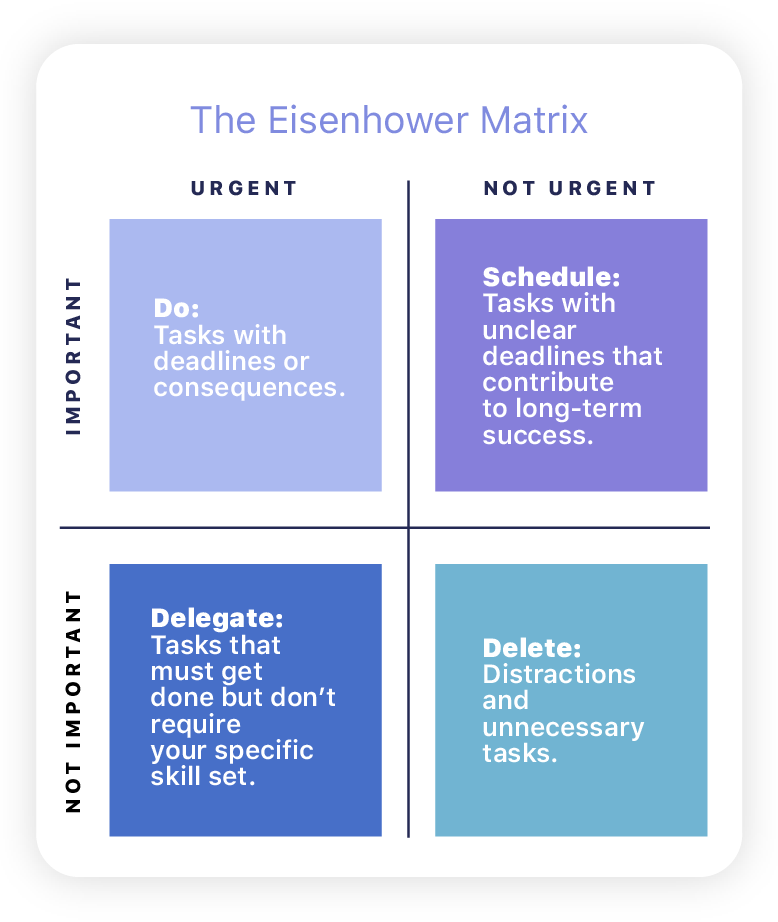
Plan the Night Before: The Multiplier Most Professionals Skip
The single most effective thing you can do for your morning is complete it the night before. This is where the high-performing morning routine is actually built.
Write Down Your Three Tasks for Tomorrow
Every evening, spend five minutes reviewing what happened during the day and writing down the three most important tasks for tomorrow. This eliminates decision fatigue at the start of the next morning and means you begin the day in execution mode rather than planning mode. A consistent to-do list management habit that maps tasks to specific time slots makes this evening review faster and more reliable over time.
Prepare Your Physical Environment
Laying out clothes, prepping breakfast ingredients, and clearing your workspace the night before removes small friction points that accumulate into a slow, unfocused start. Research on decision fatigue is consistent: small early-morning choices deplete the same cognitive resources needed for complex work later in the day.
Build a Wind-Down Routine for Better Sleep
Quality sleep is the foundation of any productive morning. A calming nighttime routine, with a consistent bedtime, reduced screen exposure in the final 30 minutes, and limited caffeine after 2 PM, directly determines your alertness and focus during the first work block. Treat the wind-down as part of the morning routine system, not separate from it.
From Morning Routine to Workday Momentum
Most productivity advice treats the morning routine and the workday as two separate things with a clean handoff. In practice, the transition point, the moment you sit down at your desk, is where the routine either pays off or collapses entirely.
For professionals at agencies and consulting firms, this transition breaks down in a predictable pattern. The first 20 to 30 minutes of the workday disappear into email triage, Slack catch-up, and the cognitive overhead of reconstructing context from the day before. The morning habits described in this article prepare your attention and intention, but they do not automatically resolve the operational friction of figuring out what to work on next.
The structural fix is having a task environment that picks up where you left off without manual reconstruction. Teams using TrackingTime can open the workday with the My Tasks view, which surfaces every task assigned across all active projects in a single screen. There is no hunting across multiple boards or rebuilding a working list from memory. From that view, starting a timer on the first task takes one click, and the first productive action of the day is logged automatically.
This matters especially for professionals who practice single-tasking as a core morning discipline. Every context switch in the first 30 minutes carries a measurable cognitive cost. Removing the administrative overhead of figuring out where to start means the focus built during the morning routine carries directly into the first work block, rather than being spent on startup overhead.
TrackingTime’s automatic time tracking feature (AutoTrack) takes this further by recording which applications and tasks you actually worked on throughout the session without any manual entry. If you skip logging during a focused block, your entries are still captured. Over time, this turns the morning routine into an operational baseline: you know not just what you planned to do, but what you actually did and when the workday started to drift from its intended direction.
Your Morning Routine Checklist
A checklist replaces willpower. Use this as a starting template and adapt it to your schedule and professional context.
The Night Before
- Write down your three most important tasks for tomorrow.
- Clear and organize your workspace.
- Lay out what you need in the morning: clothes, equipment, materials.
- Set a consistent wake-up time.
- Begin your wind-down routine at least 30 minutes before bed.
Morning Habits
- Wake at your set time, no snooze.
- Drink a glass of water before anything else.
- 10 to 20 minutes of physical movement.
- Stay off screens for the first 15 to 20 minutes.
- 5 minutes of mindfulness, breathing, or journaling.
- Eat a balanced breakfast before your first work block.
Work Startup
- Review your three priority tasks from the night before.
- Open your task management tool and confirm the day’s order.
- Block 60 to 90 minutes for your most important task.
- Set your device to Do Not Disturb.
- Start the timer on your first task and begin.


