Process Improvement Methodologies: 9 Frameworks Compared

Process improvement methodologies are structured frameworks for identifying where work breaks down and eliminating root causes systematically. This guide covers the nine most widely used approaches, explains how each one works, and gives you a decision framework to match the right methodology to the problem you’re actually solving.
💡 Quick summary
- Nine methodologies covered: Six Sigma, Lean, TQM, Kaizen, BPR, PDCA, Lean Six Sigma, TOC, and Agile
- Most initiatives underdeliver not because of a wrong methodology choice, but because no measurement baseline existed before they started
- The right choice depends on problem type, team size, and your capacity for change
- A four-step decision framework in this article directly answers “which process improvement methodology should I implement”
- Any methodology requires time data organized by project and phase to prove it worked
- TrackingTime’s Project Report and Pace feature provide that baseline for project-driven teams
Table of Contents
- Why Process Improvement Initiatives Underdeliver
- 9 Process Improvement Methodologies
- Methodology Comparison at a Glance
- How to Choose the Right Process Improvement Methodology
- Process Improvement vs. Business Process Management
- Steps for Implementing a Process Improvement Methodology
- What Process Improvement Requires from Your Time Data
- Measuring the Impact of Process Improvement
- Connect Process Improvement to Project Performance
- Frequently Asked Questions About Process Improvement Methodologies
Why Process Improvement Initiatives Underdeliver
Most process improvement initiatives don’t fail because the team chose the wrong methodology. They fail before implementation, at one of two points: the problem was misdiagnosed, or the organization had no measurement baseline to know whether anything changed.
For project-driven teams in agencies, consulting firms, and software houses, the second failure mode is especially common. An operations lead introduces Lean to eliminate wasted steps in a client delivery workflow. Six weeks later, it’s unclear whether delivery time actually improved, whether the changes are being applied consistently, or which projects benefited most. Without time data organized by project and phase, there’s nothing to compare against.
The methodology itself wasn’t the problem. The infrastructure for measuring it was missing. Solid project workflow management is what connects a chosen framework to outcomes you can actually see.
9 Process Improvement Methodologies
Each methodology below addresses a specific type of inefficiency. Some focus on defect reduction through statistical analysis, others on waste elimination, and others on iterative adaptability. Understanding the core mechanism of each helps you determine which applies to your situation.
1. Six Sigma
Six Sigma is a data-driven methodology focused on reducing defects and process variability. Developed by Motorola in 1986, the name refers to a statistical standard: operating with fewer than 3.4 defects per million opportunities. Six Sigma uses the DMAIC framework:
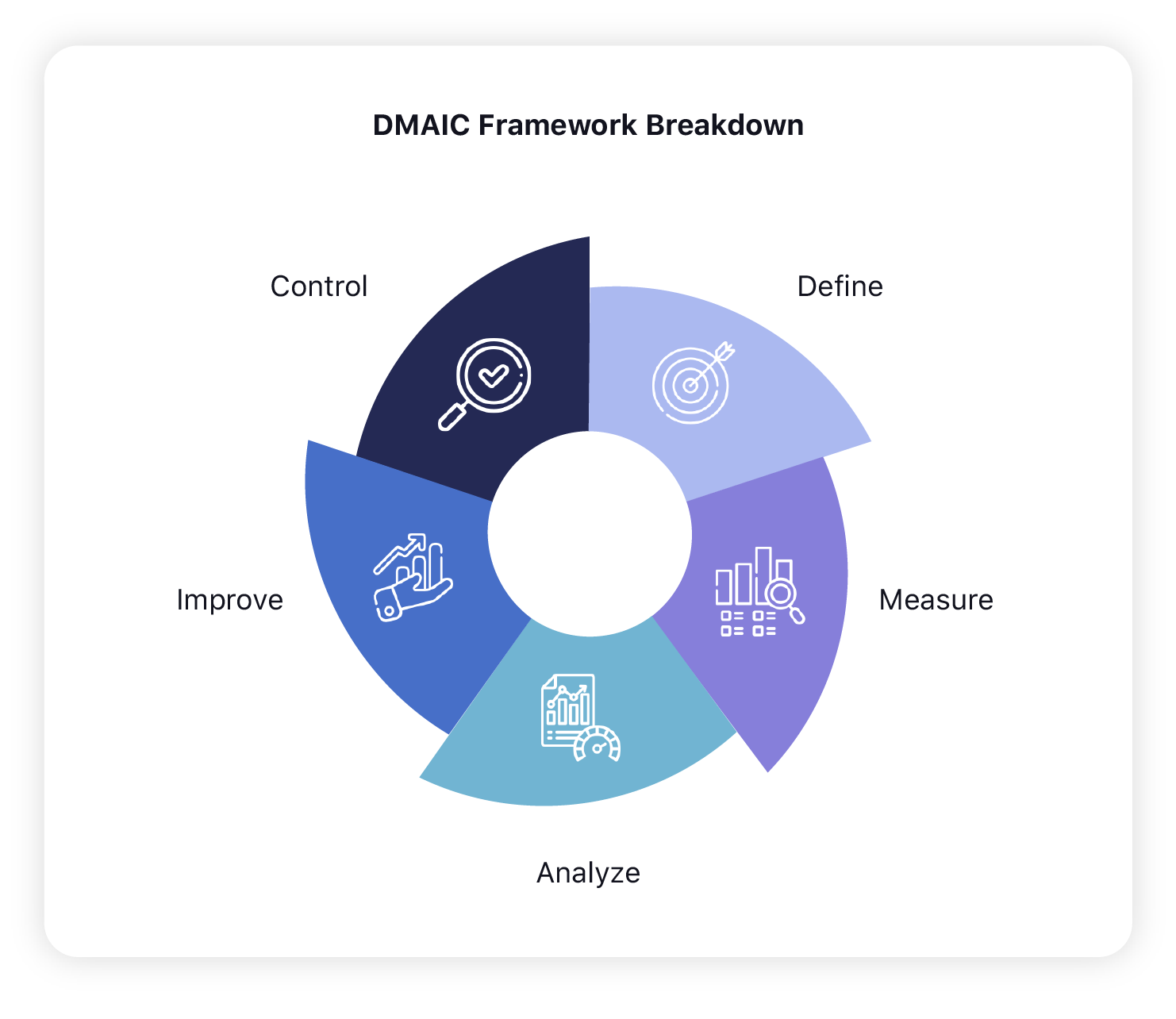
- Define — Identify the problem and set project goals.
- Measure — Collect data on current performance.
- Analyze — Investigate root causes of defects or variability.
- Improve — Implement targeted solutions.
- Control — Establish monitoring to sustain improvements.
✨ Real-world application: Hospitals use Six Sigma to reduce patient wait times and streamline admissions. Banks apply it to minimize transaction errors and improve service accuracy.
👉 Best for: Organizations where precision and defect reduction are critical — manufacturing, healthcare, finance, and quality-sensitive service operations.
2. Lean
Lean methodology originated from the Toyota Production System and focuses on eliminating waste: any activity that consumes resources without adding value for the customer. Lean identifies seven types of waste — overproduction, waiting, transport, overprocessing, inventory, motion, and defects.
A core Lean tool is the 5S methodology for workplace organization: Sort (remove unnecessary items), Set in Order (organize what remains), Shine (maintain cleanliness), Standardize (create consistent practices), and Sustain (embed these habits into culture).
Value Stream Mapping
Value stream mapping is a core Lean technique that visualizes how work moves through a process from start to finish. It maps every step involved in delivering a product or service, including information flow, production stages, waiting times, and inventory levels.
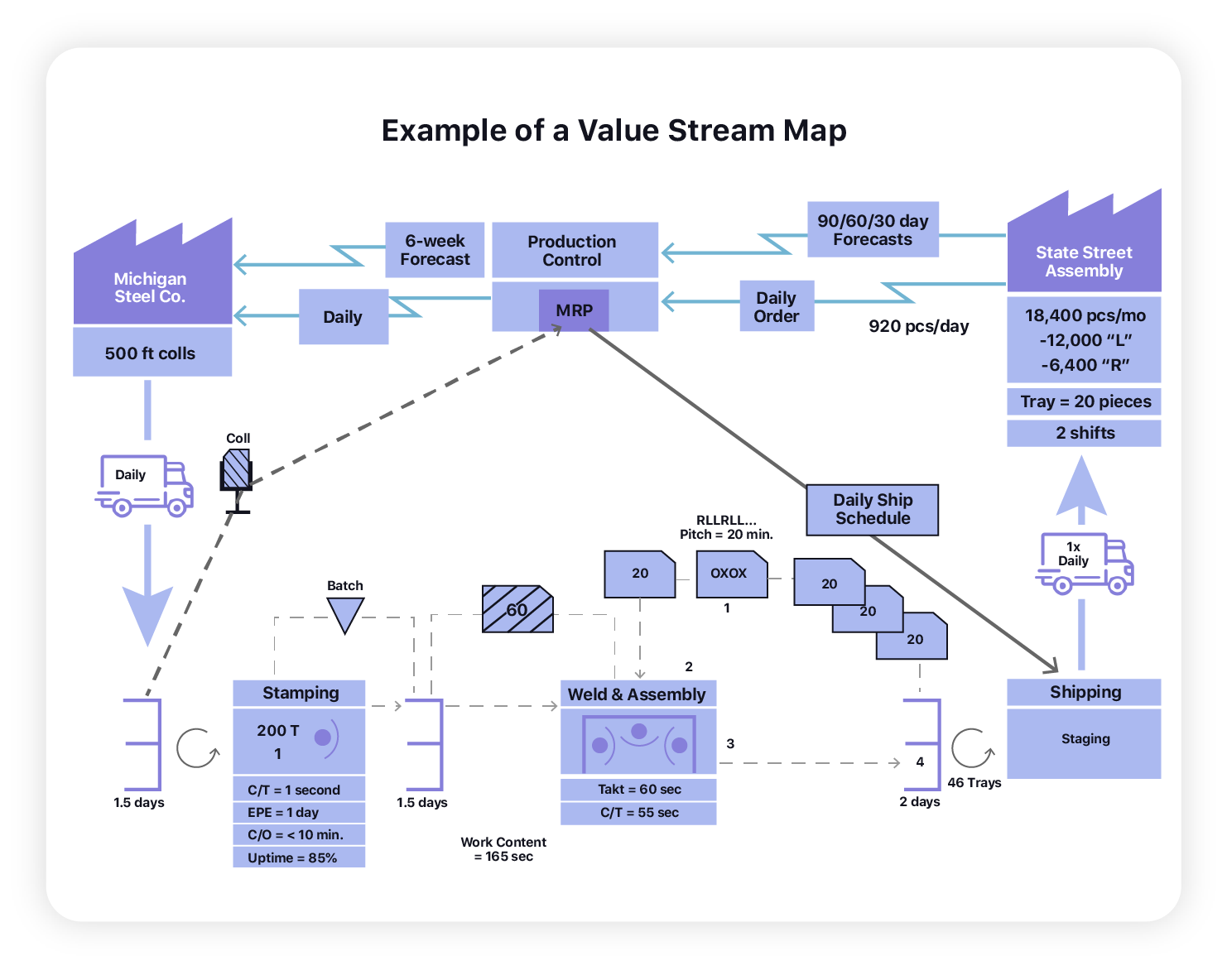
By creating a visual representation of the entire workflow, teams can identify delays, bottlenecks, and activities that don’t add value. For Lean practitioners in project-based environments, Kanban workflow management extends these principles into a visual task flow system that complements the waste-elimination mindset.
✨ Real-world application: Toyota’s Just-in-Time manufacturing produced only what was needed, when it was needed, eliminating excess inventory costs and becoming a global model for operational excellence. Boeing later applied Lean to streamline aircraft assembly, reducing production time and improving delivery schedules.
👉 Best for: Organizations cutting waste and optimizing workflows — particularly effective in manufacturing, logistics, healthcare, and any environment where resource utilization directly affects margins.
3. Total Quality Management (TQM)
TQM is a company-wide approach that embeds quality improvement into organizational culture rather than treating it as a department-level function. Every employee, from leadership to frontline workers, participates in identifying and implementing quality improvements. TQM focuses on customer satisfaction as the ultimate measure of quality.
Where Kaizen (below) drives improvement from daily habit, TQM drives it from shared organizational commitment. Teams that pair structured team management frameworks with TQM principles see stronger adoption because the cultural change has structural support behind it.
✨ Real-world application: Ford Motor Company used TQM to improve quality control across manufacturing plants, reducing defects and increasing customer satisfaction. The Ritz-Carlton applies TQM through continuous employee training to maintain service excellence.
👉 Best for: Organizations where quality is a cultural priority — hospitality, manufacturing, healthcare, and service industries where employee engagement directly impacts customer experience.
4. Kaizen
Kaizen, Japanese for “change for the better,” emphasizes continuous, incremental improvements rather than large-scale overhauls. It encourages employees at all levels to identify small inefficiencies and suggest adjustments. Over time, these minor refinements compound into significant operational gains without the risk and disruption of major process changes.
✨ Real-world application: Toyota integrates Kaizen through structured workshops where teams identify and resolve specific inefficiencies on the production line. Hospitals use the same approach to improve patient care workflows and reduce administrative waste.
👉 Best for: Organizations seeking low-risk, employee-driven improvement — effective in any environment that values ongoing optimization without requiring major investment or disruption.
5. Business Process Reengineering (BPR)
BPR takes the opposite approach to Kaizen: instead of incremental refinement, it advocates for completely redesigning core processes from scratch. BPR challenges organizations to question why work is done the way it is and restructure workflows to achieve dramatic improvements in cost, speed, and quality.
✨ Real-world application: Ford Motor Company overhauled its accounts payable system in the 1990s, replacing traditional invoice processing with a direct supplier data entry system, resulting in a 75% reduction in accounts payable headcount and significantly lower operational costs.
👉 Best for: Organizations with deep-rooted inefficiencies where incremental changes aren’t enough. BPR requires strong leadership commitment because radical redesign can face employee resistance and temporary operational disruption.
6. PDCA Cycle (Plan, Do, Check, Act)
The PDCA cycle, developed by Walter Shewhart and popularized by W. Edwards Deming, is a four-step iterative framework for testing and implementing improvements:
- Plan — Identify an improvement opportunity and develop a hypothesis.
- Do — Test the change on a small scale.
- Check — Evaluate results against expected outcomes.
- Act — Standardize what works, or refine the approach and repeat.
The cyclical nature makes PDCA particularly effective for organizations that want to test changes before committing to full-scale implementation. It’s low-risk by design: each cycle generates data that informs the next iteration.
👉 Best for: Teams seeking a simple, repeatable framework for continuous improvement — especially valuable when testing changes in manufacturing, service operations, and healthcare environments.
7. Lean Six Sigma
Lean Six Sigma combines Lean’s waste elimination focus with Six Sigma’s statistical rigor for defect reduction. The hybrid approach addresses both efficiency (doing things faster with fewer resources) and quality (doing things right with fewer errors) simultaneously.
✨ Real-world application: General Electric leveraged Lean Six Sigma to improve manufacturing efficiency, reduce cycle times, and enhance quality across its operations, resulting in billions of dollars in documented savings.
👉 Best for: Organizations that need to improve both speed and precision — particularly effective in manufacturing, healthcare, finance, and logistics where efficiency and quality are equally critical.
8. Theory of Constraints (TOC)
TOC, developed by Dr. Eliyahu M. Goldratt, is built on a simple principle: every system has at least one bottleneck that limits overall throughput. Instead of trying to improve everything at once, TOC focuses all improvement effort on identifying and resolving the single most critical constraint. Once that constraint is resolved, the next bottleneck becomes the focus.
This targeted approach prevents the dilution of improvement effort across too many initiatives. By concentrating resources on the weakest link, organizations maximize the impact of every improvement dollar spent.
👉 Best for: Organizations struggling with identifiable bottlenecks that limit output — manufacturing, logistics, healthcare, and any operation where one constraint disproportionately affects overall performance.
9. Agile
Agile is an iterative approach to work management that breaks projects into short cycles (sprints) of two to four weeks. Instead of following a fixed, linear plan, teams continuously gather feedback, reassess priorities, and adjust their approach. This makes Agile particularly effective in environments where requirements evolve and rigid planning creates more problems than it solves.
Agile’s strength is adaptability. Teams deliver working increments frequently, allowing stakeholders to evaluate progress and redirect effort before significant resources are committed to the wrong direction. Integrating Agile with structured project planning processes ensures that flexibility doesn’t come at the cost of strategic alignment.
👉 Best for: Dynamic environments where requirements change frequently — software development, marketing, product management, and any project-based work where responsiveness to feedback is more valuable than plan adherence.
Methodology Comparison at a Glance
This table summarizes the core characteristics of each methodology to help you quickly identify which frameworks align with your operational context.
| Methodology | Core Focus | Approach | Best For |
|---|---|---|---|
| Six Sigma | Defect reduction | Data-driven (DMAIC) | Precision-critical industries |
| Lean | Waste elimination | Systematic (5S, JIT) | Manufacturing, logistics |
| TQM | Organization-wide quality | Cultural (total involvement) | Customer-facing, service |
| Kaizen | Incremental improvement | Bottom-up, continuous | Any team, low-risk entry |
| BPR | Radical redesign | Top-down transformation | Deep-rooted inefficiencies |
| PDCA | Iterative testing | Cyclical experimentation | Small-scale validation |
| Lean Six Sigma | Efficiency + quality | Hybrid (Lean + DMAIC) | Complex operations |
| TOC | Bottleneck resolution | Constraint-focused | Throughput-limited systems |
| Agile | Adaptability | Iterative sprints | Dynamic, evolving projects |
How to Choose the Right Process Improvement Methodology
Selecting the right methodology depends on three factors: the nature of the problem you’re solving, the scale of change required, and the organizational context in which you’re operating. This decision framework helps you match your situation to the right approach.
Step 1: Define the Problem Type
Start by classifying the core issue you need to address:
- Quality and defect issues — Errors, rework, inconsistent output → Six Sigma or Lean Six Sigma
- Waste and inefficiency — Redundant steps, overproduction, idle resources → Lean
- Bottlenecks limiting throughput — One constraint blocking overall performance → TOC
- Processes that need a complete overhaul — Fundamentally broken workflows → BPR
- Need for continuous, low-risk improvement — Ongoing refinement culture → Kaizen or PDCA
- Rapidly changing requirements — Evolving priorities, frequent feedback cycles → Agile
Step 2: Assess Organizational Readiness
Not every methodology fits every team. Consider your organization’s capacity for change:
- Small teams (under 25 people): Start with Kaizen or PDCA. These require minimal training investment and generate quick wins that build momentum for larger improvements.
- Mid-size organizations (25–200 people): Lean, Agile, or TOC provide structured frameworks that scale across departments without requiring enterprise-level infrastructure.
- Large enterprises (200+ people): Six Sigma, Lean Six Sigma, or TQM offer the rigor and governance structures needed for organization-wide programs. These typically require dedicated roles (Black Belts, process owners) and executive sponsorship.
Step 3: Match to Industry Context
Some methodologies align more naturally with specific industries. Manufacturing environments benefit most from Lean and TOC. Service organizations often see the greatest impact from TQM and Kaizen. Technology and creative teams gravitate toward Agile. Finance and healthcare, where errors carry significant consequences, find the most value in Six Sigma’s data-driven rigor.
These aren’t rigid boundaries. The decision framework above should prioritize the nature of your problem over industry convention. Keeping clear records of improvement initiatives through structured project reporting helps you evaluate whether your chosen methodology is delivering the expected results.
Step 4: Consider Combining Methodologies
Many organizations use multiple methodologies simultaneously. Lean Six Sigma is the most common hybrid, but teams also combine Agile with Kaizen (continuous improvement within sprint retrospectives) or PDCA with TOC (iteratively testing solutions for identified bottlenecks). Start with one methodology, build competency, and layer additional frameworks as your improvement capability matures.
Process Improvement vs. Business Process Management
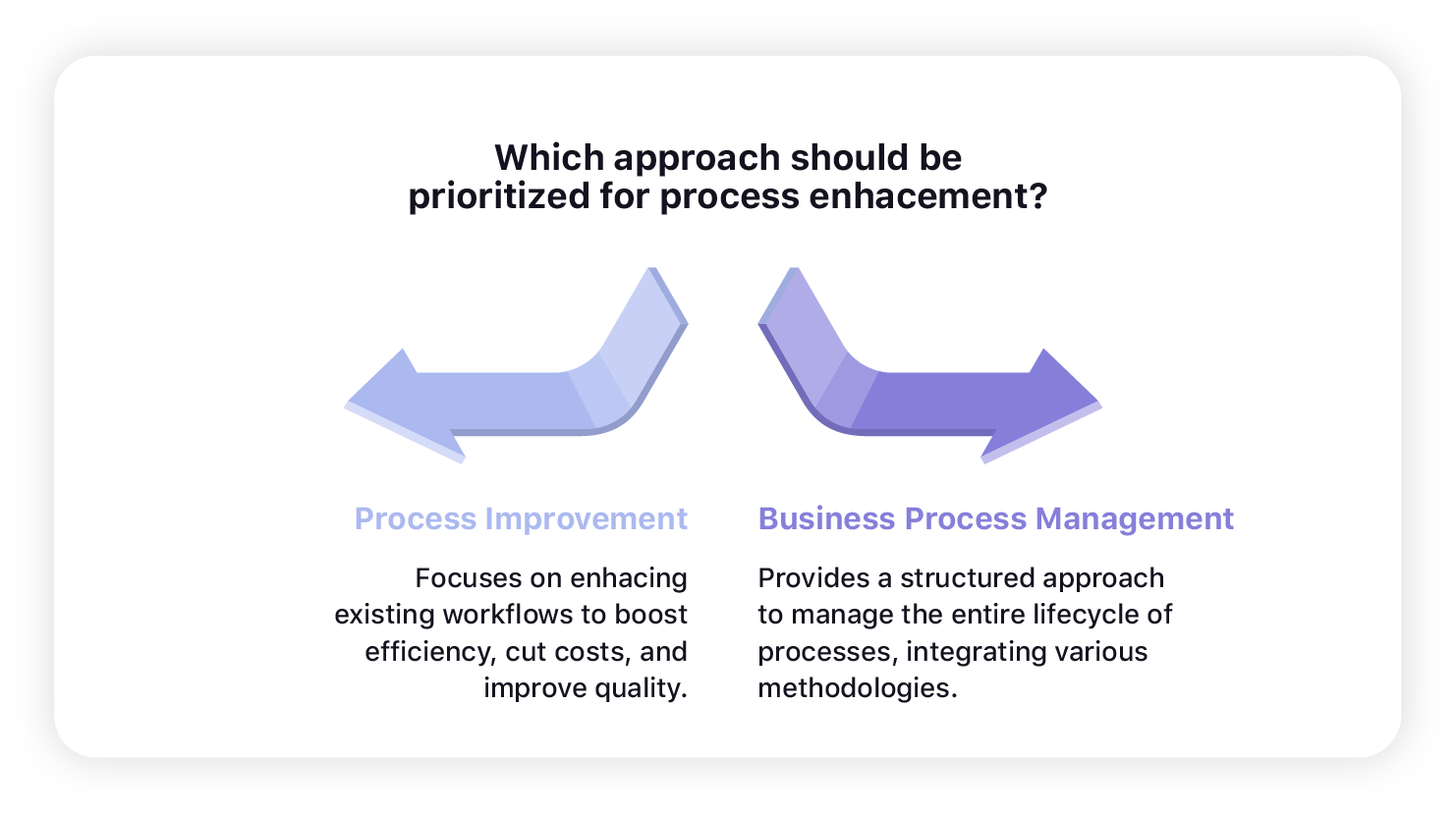
These terms are related but distinct. Process improvement focuses on enhancing specific workflows: identifying inefficiencies and implementing targeted changes. Business Process Management (BPM) is a broader discipline that involves defining, modeling, executing, monitoring, and continuously optimizing processes across the entire organization.
Think of process improvement as a specific intervention and BPM as the ongoing management system that sustains those interventions over time. Organizations that combine both — using improvement methodologies within a BPM framework — see the strongest results. Research shows that companies with effective process management achieve 20–50% efficiency gains and are 2.5 times more likely to lead their industry.
Steps for Implementing a Process Improvement Methodology
Regardless of which methodology you choose, the implementation process follows a consistent pattern. These steps apply to any framework and provide a structured path from problem identification to sustained improvement.
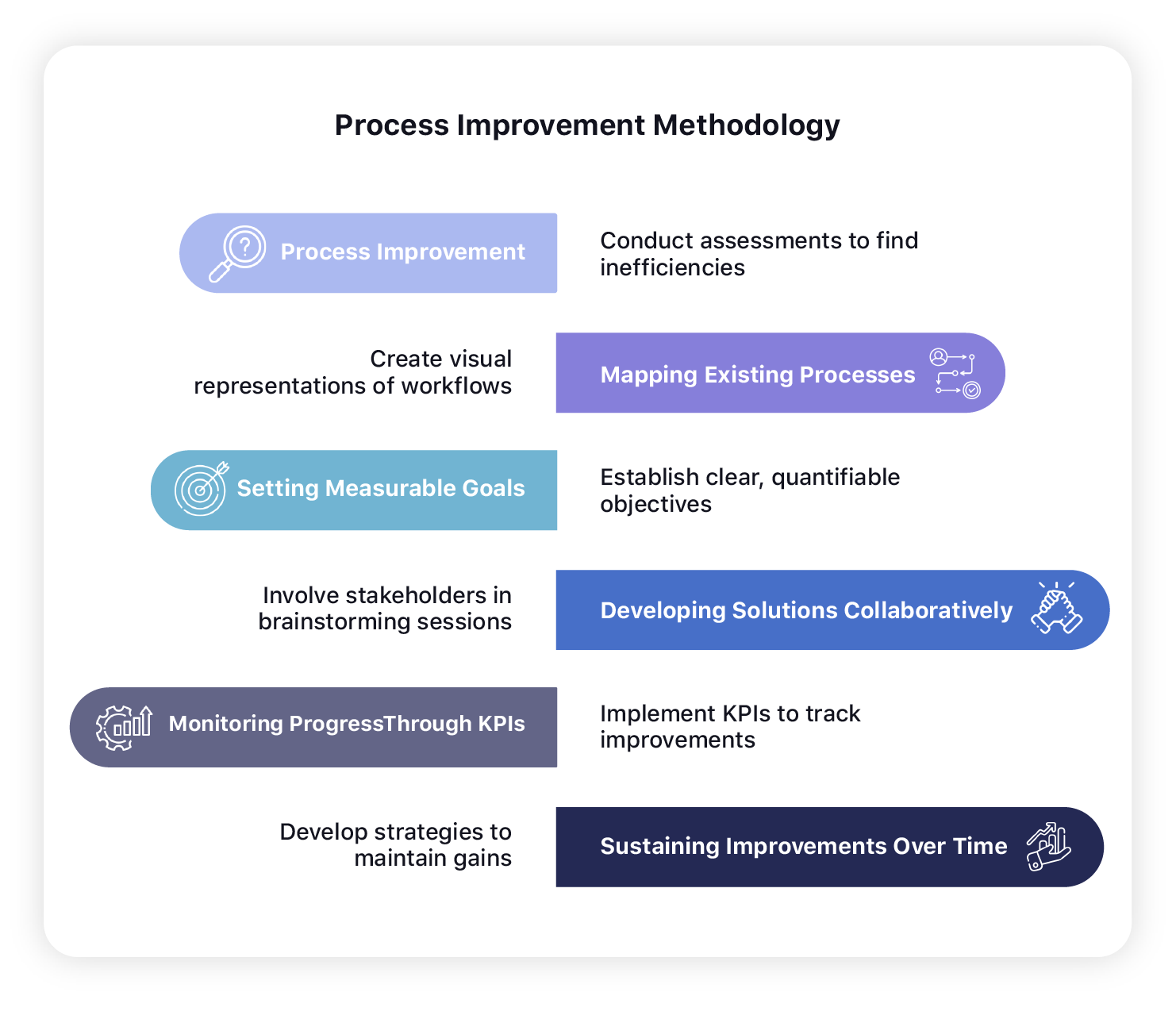
- Identify problem areas. Use performance metrics, employee feedback, and process audits to pinpoint where inefficiencies exist. The people who do the work daily often see bottlenecks that metrics alone miss. Maintaining a RAID log helps capture and prioritize the problems that surface during this assessment.
- Map existing workflows. Visualize how work currently flows using process maps, flowcharts, or value stream maps. This makes redundancies, handoff delays, and unnecessary steps visible to all stakeholders.
- Set measurable goals. Define specific, quantifiable targets using the SMART framework (Specific, Measurable, Achievable, Relevant, Time-bound). For example: reduce order processing time from 48 hours to 24 hours within three months.
- Develop solutions collaboratively. Involve key stakeholders in designing improvements. Cross-functional input produces more robust solutions and builds the buy-in needed for successful adoption. A clear team charter defines roles and accountability during the improvement initiative.
- Implement and test. Deploy changes on a controlled scale first. PDCA’s test-and-learn cycle applies here regardless of which primary methodology you’re using: validate that the change works before rolling it out broadly.
- Monitor with KPIs. Track key performance indicators to measure whether improvements deliver the expected results. Review these metrics regularly and adjust if outcomes fall short of targets.
- Sustain improvements. Integrate successful changes into standard operating procedures, provide ongoing training, and establish regular review cycles. Improvement that isn’t embedded into daily practice reverts to old patterns within months.
Standardizing these implementation steps across your organization using consistent project management templates ensures that every improvement initiative follows a proven structure rather than starting from scratch.
What Process Improvement Requires from Your Time Data
This is where most teams hit a wall they didn’t see coming.
A consulting firm adopts Lean to streamline client delivery. A marketing agency introduces Kaizen retrospectives after every campaign. A software team starts running PDCA cycles on their sprint process. Six months later, leadership asks: is it working?
Without a time data baseline, tracked at the project and task level before and after the changes, there’s no defensible answer. The improvement happened in someone’s perception, not in the numbers.
This failure mode is consistent across project-driven organizations. Teams that operate without visibility into how hours are actually distributed across projects, clients, and phases can run a textbook Lean implementation and still be unable to demonstrate what changed. The problem isn’t the methodology. It’s that the measurement infrastructure wasn’t in place before the initiative started.
For agencies and professional services teams, this plays out in a predictable pattern. A digital agency running a dozen client retainers detects that delivery is taking longer than scoped, but only at month-end when the retainer has already been exceeded. An operations team at a consulting firm spends weeks assembling time reports manually from spreadsheets to present at quarterly reviews. The process improvement initiative was designed to reduce delivery time, but no one had tracked baseline hours per phase before the changes were made.
When the measurement layer is built into the same environment where work happens — tasks, projects, and time entries in one place — the before/after comparison becomes automatic. You can see how long a specific phase took before a Kaizen change and how long it takes now. You can identify which projects absorbed the most unplanned time, which is exactly the constraint data TOC requires. The pace at which a project is consuming its estimated hours becomes visible in real time, not three weeks after the deadline passed.
Measuring the Impact of Process Improvement
Process improvement without measurement is guesswork. These metrics provide a clear picture of whether your methodology is delivering results:
- Cycle time reduction: How much faster does the process complete compared to baseline?
- Defect rate: Has the frequency of errors, rework, or quality issues decreased?
- Cost savings: What is the measurable reduction in labor, materials, or overhead costs?
- Employee productivity: Are teams producing more output per hour? Tracking time against specific process steps reveals where productivity gains actually occur.
- Customer satisfaction: Have improvements in process quality translated to better outcomes for end users?
Connecting each of these metrics to the relevant project and phase, rather than measuring them at an aggregate level, is what separates organizations that can demonstrate improvement ROI from those that can only describe it. Consistent project tracking practices are what make that level of granularity possible.
Connect Process Improvement to Project Performance
Process improvement methodologies deliver the most value when they’re integrated into how your team manages projects, not treated as standalone initiatives. Better processes produce more predictable timelines, tighter cost control, and higher-quality deliverables.
The project management resource hub provides additional frameworks, templates, and guides to help teams connect process improvements with measurable project performance — from planning through delivery and review.
Frequently Asked Questions About Process Improvement Methodologies
What are the most commonly used process improvement methodologies?
The most widely used are Lean, Six Sigma, Kaizen, PDCA, and Agile. Each addresses a different type of operational problem: Lean targets waste, Six Sigma targets defects, Kaizen targets incremental improvement, PDCA targets iterative testing, and Agile targets adaptability in changing environments.
How do I choose between Six Sigma and Lean?
Use Six Sigma when the core problem is measurable defects, quality inconsistency, or process variability that requires statistical analysis. Use Lean when the core problem is waste — redundant steps, overproduction, idle resources, or unnecessary delays. Lean Six Sigma combines both approaches for organizations that need to improve speed and quality simultaneously.
Can small teams use process improvement methodologies?
Yes. Kaizen and PDCA are well-suited to small teams because they require minimal infrastructure and generate results through incremental changes rather than large-scale programs. A team of five can run a PDCA cycle within a single sprint without dedicated process roles or certification requirements.
What is the difference between process improvement and BPM?
Process improvement refers to targeted interventions that fix specific inefficiencies. Business Process Management (BPM) is the broader discipline that governs how processes are defined, monitored, and continuously optimized across an organization. Process improvement is a technique; BPM is the management system that can incorporate multiple improvement techniques over time.
How long does it take to see results from a process improvement initiative?
It depends on the methodology and scope. PDCA cycles and Kaizen events can show measurable results within two to four weeks for targeted problems. Lean implementations at the department level typically show clear results within three to six months. Six Sigma projects run six to twelve months on average due to data collection and statistical analysis requirements. BPR, as a radical redesign approach, can take twelve to eighteen months before the full impact is measurable.


