What Is Scope Creep? Causes, Examples, and How to Prevent it

Scope creep is the uncontrolled expansion of a project’s scope beyond its original goals, deliverables, or requirements—without adjusting time, budget, or resources. It typically occurs when small changes are introduced during execution without formal review, gradually shifting the project beyond its original boundaries.
💡 Quick Summary
- Scope creep is the gradual expansion of a project’s scope beyond its original plan.
- It usually happens due to unclear requirements, informal change requests, and misalignment between stakeholders and teams.
- Unlike controlled scope changes, scope creep occurs without formal review or adjustments to the project plan.
- Scope creep leads to delays, budget overruns, increased workload, and reduced project control.
- Preventing scope creep requires clear scope definition, structured change control, and ongoing alignment.
Scope Creep
- What Is Scope Creep in Project Management?
- Project Scope vs Scope Creep
- Why Scope Creep Happens: The Most Common Causes
- Common Warning Signs of Scope Creep to Watch For
- Scope Creep Examples (Real Project Scenarios)
- How Scope Creep Affects Projects
- How to Prevent Scope Creep
- Scope Creep Prevention Checklist
- Avoid Scope Creep and Hit Deadlines
What Is Scope Creep in Project Management?
In project management, scope creep appears when additional work is introduced after execution begins without being formally reviewed or incorporated into the project plan.
The issue is not that the project changes. In many cases, change is expected and necessary. Scope creep happens when those changes are handled informally and begin to accumulate without clear visibility or control.
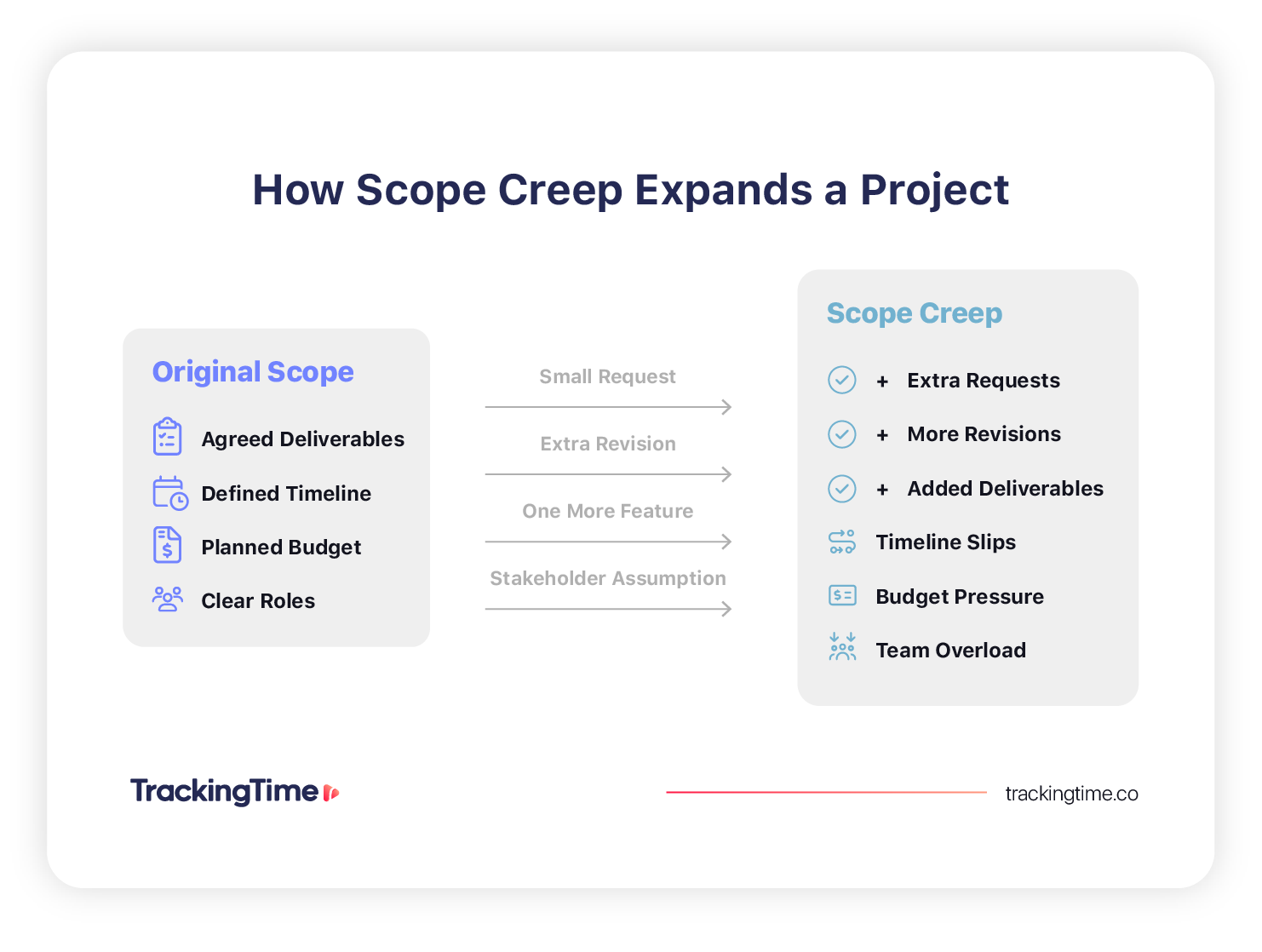
Scope creep often starts with small requests that seem reasonable on their own. A stakeholder asks for an extra deliverable, a client requests additional revisions, or a team member takes on work that was not originally planned. Over time, these additions build up and begin to affect timelines, workload, and overall direction.
As a result, scope creep can lead to delays, budget pressure, confused expectations, and a growing gap between what was planned and what the team is actually being asked to deliver.
💡 What is Project Scope?
Project scope defines the boundaries of a project. It outlines what work will be done, what deliverables are expected, and what is explicitly excluded. A clearly defined scope gives teams a reference point for evaluating changes during execution.
Project Scope vs Scope Creep
To fully understand scope creep, it’s important to distinguish it from a controlled scope change. In project management, changes can happen for valid reasons. The difference is that a controlled scope change is formally reviewed and reflected in the timeline, budget, or resources, while scope creep builds gradually and informally.
The difference becomes clearer when comparing how each is handled in practice:
| Criteria | Project Scope Change | Scope Creep |
|---|---|---|
| Approval | Formally reviewed and approved | Added informally or without approval |
| Process | Managed through a defined change process | Happens gradually and without control |
| Timeline and budget | Adjusted when needed | Extra work is absorbed without adjustment |
| Visibility | Clear to stakeholders | Often noticed only after problems appear |
Why Scope Creep Happens: The Most Common Causes
Scope creep rarely happens because of a single decision. It usually emerges from gaps in planning, communication, and change management during the project lifecycle.
Some of the most common causes are:
1. Unclear project requirements
When goals or boundaries are not clearly defined, teams leave room for interpretation. Vague requirements, missing details, or incomplete discovery often make it easier for extra work to appear later as the project progresses.
2. Informal stakeholder requests
Scope creep often begins with small requests that seem harmless at first. An extra revision, one more feature, or an additional deliverable may not sound significant on their own, but these additions can accumulate quickly.
💡 A valuable request can still be out of scope
Not every extra request is a bad idea. The problem is not whether the request has value, but whether the team treats it as part of the original scope without reviewing its impact.
3. Poor change control
Projects are more likely to drift when there is no clear process for reviewing and approving changes. Without change control, new requests can be absorbed into the work without anyone formally deciding how they affect scope, timeline, or budget.
4. Weak communication and alignment
Clients, managers, and teams do not always share the same understanding of what the project includes. When expectations are not clarified early and revisited during execution, hidden scope expansion becomes much more likely.
👉 Fast agreement can create slow delivery
Saying yes too quickly can make a project harder to deliver later. A short pause to review impact often protects the timeline better than immediate agreement.
5. Shifting business priorities
Projects often change direction when priorities shift, market conditions change, or leadership introduces new requests. In those situations, the scope can expand mid-project even if the original plan was clear at the start.
Common Warning Signs of Scope Creep to Watch For
Scope creep is easier to manage when teams can identify it early. The following warning signs often indicate that a project is drifting beyond its original scope:
- Repeated new requests: New requests keep appearing after the original scope was approved
- Unexplained timeline slippage: Deadlines start moving without one clear cause
- Misaligned expectations: Stakeholders assume certain deliverables were part of the project when they were not
- Rising budget pressure: Costs increase without a formal scope update
- Constant priority shifts: Priorities keep changing during execution
- Outdated documentation: Project documents no longer match the work actually being done
👉 Scope creep is often a visibility problem
In many cases, teams lose control because added work is not made visible early enough to trigger the right conversation.
Scope Creep Examples (Real Project Scenarios)
These examples show how projects can expand beyond their original boundaries when new work is added without formally updating the plan. These real-world scenarios show how scope creep develops in different types of projects:
Scope Creep in a Marketing Project
The marketing team starts a campaign with a defined scope, including strategy, landing page content, and a launch plan for two channels. Once execution begins, additional requests start coming in: social media assets, extra copy revisions, and reporting for additional stakeholders.
As a result, the campaign timeline extends, the workload increases, and the original scope becomes difficult to manage without adjustments.
Scope Creep in a Web Redesign Project
A web redesign begins with a clear agreement: refresh the homepage, update key service pages, and improve navigation. As the project moves forward, stakeholders request an additional landing page, new copy for existing sections, and integrations that were never discussed at the start.
This leads to delays, additional costs, and growing misalignment between stakeholders and the original project plan.
Scope Creep in a Software Development Project
A product team starts building a feature with an agreed set of requirements and a target delivery date. During development, stakeholders request additional filters, custom dashboards, more permission settings, and workflow changes as new ideas arise.
Over time, these additions increase complexity and delay delivery without a clear adjustment to resources or deadlines.
Scope Creep in an Internal Operations Project
An internal operations project begins as an effort to improve one reporting process for a single team. As work progresses, other departments ask to include their own approval steps, documentation needs, and workflow changes. What started as a focused improvement project becomes a broader cross-functional initiative, even though the timeline, ownership, and resources were never redefined.
This expansion creates coordination challenges and makes the project harder to deliver within the original scope and timeline.
How Scope Creep Affects Projects
Scope creep does not just add more work. It affects timelines, budgets, workload, and decision-making. Some of the most common consequences of scope creep include:
Delays and missed deadlines
When work expands beyond the original plan, the timeline often starts to slip. Even small additions can slow progress, especially when they interrupt priorities.
Budget overruns
Extra work increases cost. When scope changes are absorbed without formal updates, projects can exceed their budget without a clear explanation of why.
Team overload and lower morale
Teams often feel the impact of scope creep first. As extra requests appear, workloads become harder to manage, priorities become less clear, and frustration tends to grow.
Reduced quality
When teams are expected to deliver more without additional time or resources, quality suffers. Work is rushed, reviews become less thorough, and important details may be missed.
Blurred accountability
Scope creep makes it harder to know who approved what, which tasks were part of the original plan, and what the team is actually responsible for delivering. This can create confusion across stakeholders and reduce ownership.
Project profitability and delivery risk
As work expands without control, the project becomes harder to deliver efficiently. Timelines become less predictable, margins can shrink, and the risk of missing goals increases.
How to Prevent Scope Creep
Preventing scope creep requires a structured approach. The goal is not to avoid change entirely, but to ensure that every change is properly evaluated and aligned with project goals.
Here’s a practical guide on how to prevent scope creep in project management:
1. Define the scope clearly from the start
The best way to reduce scope creep is to make the original scope as clear as possible before execution begins. That means documenting not only what the project will deliver, but also what it will not include. A strong scope definition should outline the main deliverables, key requirements, assumptions, exclusions, owners, and approval points so everyone begins with the same understanding.
This matters because scope creep often begins in the gaps. When goals are vague or exclusions are not stated, teams leave room for interpretation. Later, those missing details can turn into additional requests, conflicting expectations, or work that ‘seemed included’ but was never formally agreed on.
A clearly defined scope gives the team a practical reference point throughout the project. It makes it easier to evaluate new requests, clarify misunderstandings, and protect the project from drifting beyond its original boundaries.
2. Use a statement of work or project brief
A statement of work or project brief gives the project a clear written foundation. It brings together the core elements of the work in one place, including objectives, deliverables, scope boundaries, responsibilities, timeline expectations, and key assumptions. When this information is documented early, teams have a shared point of reference for what the project includes and what it does not.
This is important because scope creep often starts when expectations live in different places or remain too open to interpretation. A project brief or SOW helps reduce that ambiguity by turning expectations into something visible and easier to align around.
It also makes change easier to manage later. When new requests appear, the team can compare them against the original agreement and decide whether they fit within the existing scope or require a formal update.
💡 These resources can help you create a stronger foundation from the start:
3. Create a change request process
Projects need a clear way to evaluate changes before they become part of the work. A simple change request process helps teams assess new requests instead of absorbing them automatically. The process doesn’t have to be heavy or bureaucratic. It can be as simple as documenting the request, reviewing its impact, and deciding whether it should be approved, postponed, rejected, or traded off against existing priorities.
A simple review step creates space for better decisions. It helps teams ask practical questions such as whether the request supports the project goals, whether something else needs to move to make room for it, and who needs to approve the change before work begins.
4. Align stakeholders early and often
Scope creep is less likely to happen when everyone is on the same page about what the project is meant to deliver, what its limits are, and how decisions will be handled along the way. Early alignment helps teams clarify goals, priorities, constraints, and approval expectations. That shared understanding gives the project a stronger foundation and reduces the chances of conflicting assumptions surfacing later.
Regular check-ins help keep that alignment in place as the project moves forward. They create space to confirm priorities, revisit expectations, and address misunderstandings before they become larger delivery problems. In practice, consistent alignment is what helps teams recognize whether a new request fits the original scope or requires a deliberate change.
5. Track work against the original plan
Projects are easier to keep under control when teams regularly compare the work being done against what was originally agreed. This means checking actual tasks, deliverables, and requests against the original scope instead of assuming the project is still on track.
By reviewing real work against agreed-upon deliverables, teams can decide whether a change falls within scope or should be handled as a formal update.
Tracking against the original plan also improves conversations around accountability, progress, and project health. It gives teams a clearer basis for discussing what has changed, what remains aligned, and whether the timeline or budget needs to be adjusted in response.
💡 Use these resources to monitor progress and keep work aligned with the original plan:
6. Clarify roles, responsibilities, and decision rights
To prevent scope creep, everyone needs to understand who owns the work, who reviews progress, and who has the authority to approve changes. Clear roles help make decisions faster and reduce the risk of extra work being accepted without the right level of review.
This matters because unclear responsibility often creates hidden expansion. A team member may respond directly to a stakeholder request, a manager may assume someone else approved the change, or different people may have different ideas about who is responsible for protecting the scope. Over time, that ambiguity makes it harder to control what gets added and why.
Clarifying roles and decision rights creates a stronger structure for managing requests consistently. It helps teams know who is accountable for the work, who needs to be consulted before changes are accepted, and who makes the final call when priorities conflict.
💡 These resources help clarify responsibilities and support more consistent decision-making:
Scope Creep Prevention Checklist
Scope creep is not caused by change—it’s caused by unmanaged change. Use this checklist to keep work aligned with the original scope before and during project execution:
- Project goals are clearly defined
- Deliverables are documented and approved
- Scope exclusions are explicitly listed
- Stakeholders are aligned on expectations
- A change request process is in place
- New requests are reviewed before approval
- Timeline and budget are updated when scope changes
- Work is tracked against the original plan
- Roles, ownership, and approvals are clearly assigned
- Warning signs of scope creep are reviewed regularly
Avoid Scope Creep and Hit Deadlines
Scope creep can start with small, reasonable changes, but over time, it can push a project beyond its original goals, timeline, and budget.
The key is not to avoid all change, but to manage it with clear scope, better alignment, and a process for evaluating new requests. When teams catch scope drift early, they are far more likely to keep projects on track and deliver with confidence.
Using structured project management practices helps teams maintain visibility, evaluate changes effectively, and keep projects aligned with their original scope.
🏆 Explore Related Resources for Better Project Management
Frequently Asked Questions About Scope Creep
Is scope creep a project risk?
Yes. Scope creep is a project risk because it can affect deadlines, budgets, workload, and delivery quality. When extra work is added without proper review, the project becomes more likely to miss its original targets.
Who is responsible for managing scope creep?
Managing scope creep is usually a shared responsibility. Project managers lead the process, but clients, stakeholders, team leads, and delivery teams all play a role in keeping requests visible, reviewing changes, and protecting the agreed scope.
How does agile handle scope creep?
Agile does not eliminate scope changes, but it manages them differently. New requests are usually reviewed and prioritized in the backlog, then scheduled into future sprints instead of being added informally during active work.
How should you respond to scope creep?
The best response is to make the new request visible, assess its impact, and decide whether to approve it, postpone it, reject it, or replace another priority. The key is not absorbing extra work without discussion.
What’s the opposite of scope creep?
The opposite of scope creep is controlled scope change. That means changes are documented, reviewed, approved, and reflected in the project plan.
Is scope creep good or bad?
Scope creep is usually negative because it adds work without proper alignment or adjustment. However, the underlying request may still be valuable. The issue is not the change itself, but the lack of visibility and control around it.
How can scope creep be measured?
Scope creep can be measured by comparing the original scope against actual work delivered. Teams often look at added tasks, extra revisions, increased hours, delayed milestones, or budget changes that were not part of the initial plan.
How much can scope creep cost a project?
The cost of scope creep depends on the project, but it often appears as extra labor, delayed delivery, lower margins, rework, and reduced team capacity.
Is scope creep a project management failure?
Not always. Scope creep can happen even in well-run projects, especially when priorities change or stakeholders keep adding requests. It becomes a project management failure when those changes are not made visible, evaluated, and managed properly.


