What Are Working Hours? Types, Examples & Structure

Working hours are the periods of time during which employees are expected to perform their job. They determine when work happens, how many hours are required, and how teams coordinate availability and coverage across a day or week.
Types of Working Hours
| Type | How It Works | Example | Best Used For |
|---|---|---|---|
| Standard | Fixed start and end times | 9 AM–5 PM, Monday–Friday | Predictable schedules and team coordination |
| Flexible | Employees choose start and end times within agreed limits | 8 AM–4 PM or 10 AM–6 PM | Autonomy, hybrid work, and work-life balance |
| Part-time | Fewer weekly hours than a full-time role | 20–30 hours per week | Role-specific coverage or reduced schedules |
| Overtime | Extra hours worked beyond standard expectations | 45+ hours in one week | Workload peaks, urgent projects, or deadlines |
| Shift-based | Work is divided into scheduled time blocks | Morning, evening, or night shifts | Extended coverage or 24/7 operations |
💡 Quick Summary
- Working hours refer to the scheduled time employees are expected to work.
- Common types include full-time, part-time, fixed schedules, flexible schedules, shift work, and compressed workweeks.
- Clear working hours improve team coordination, ensure fair workload distribution, and help businesses stay compliant with labor regulations.
- Work time is tracked using time tracking tools, digital time clocks, or time and attendance systems.
Working Hours: Meaning, Types & Examples
- Types of Working Hours
- What Are Working Hours? (Meaning and Definition)
- How Work Hours Are Structured
- The Main Types of Working Hours
- Examples of Work Hour Structures
- Working Hours vs Schedule vs Shift
- Why Work Hours Matter for Planning and Team Coordination
- How Work Hours Are Tracked
- Understanding Work Time in Practice
What Are Working Hours? (Meaning and Definition)
Working hours refer to the set amount of time employees are expected to perform their job, typically defined per day or week (for example, 8 hours per day or 40 hours per week). They establish clear expectations for when duties happen and how teams coordinate their availability.
Working hours are used to organize how time is allocated across tasks, teams, and responsibilities. In practice, they help define three essential aspects of how labor is structured:
- Availability: the specific times employees are expected to be active
- Capacity: the total number of hours assigned to a role or schedule
- Coverage: ensuring people are working at the right times to coordinate effectively
By setting clear working time, organizations create a foundation for planning workloads, maintaining coverage, and keeping teams aligned throughout the workday or week. This makes working hours a key concept for planning work, managing availability, and coordinating teams.
According to a 2025 Global study published by the National Bureau of Economic Research, employed people worldwide work an average of 42 hours per week, which highlights how full-time work still concentrates around a consistent weekly structure across countries.
How Work Hours Are Structured
In practice, working hours are structured to define when people work, how long they work, and how teams stay coordinated. Organizations typically structure business hours around these key elements:
- Daily vs. weekly hours: Work expectations are often defined as the total number of hours per day and week (e.g., 8 hours per day, 40 hours per week).
- Start and end times: these define when the workday begins and ends, either as fixed times or within a flexible range.
- Breaks and unpaid time: schedules usually include designated breaks (such as lunch), which may or may not count toward total business hours.
- Core hours vs. flexible ranges: some teams require employees to be available during specific “core hours,” while allowing flexibility outside of those times.
- Coverage requirements: work schedule is often structured to ensure that the right people are available at the right times, especially in teams that rely on collaboration or continuous operations.
By combining these elements, organizations create a structure that balances individual flexibility with team coordination and business needs.
💡 In short, working hours are typically structured around:
- Total hours (daily or weekly)
- Start and end times
- Breaks and unpaid time
- Core hours and flexibility
- Coverage requirements
The Main Types of Working Hours
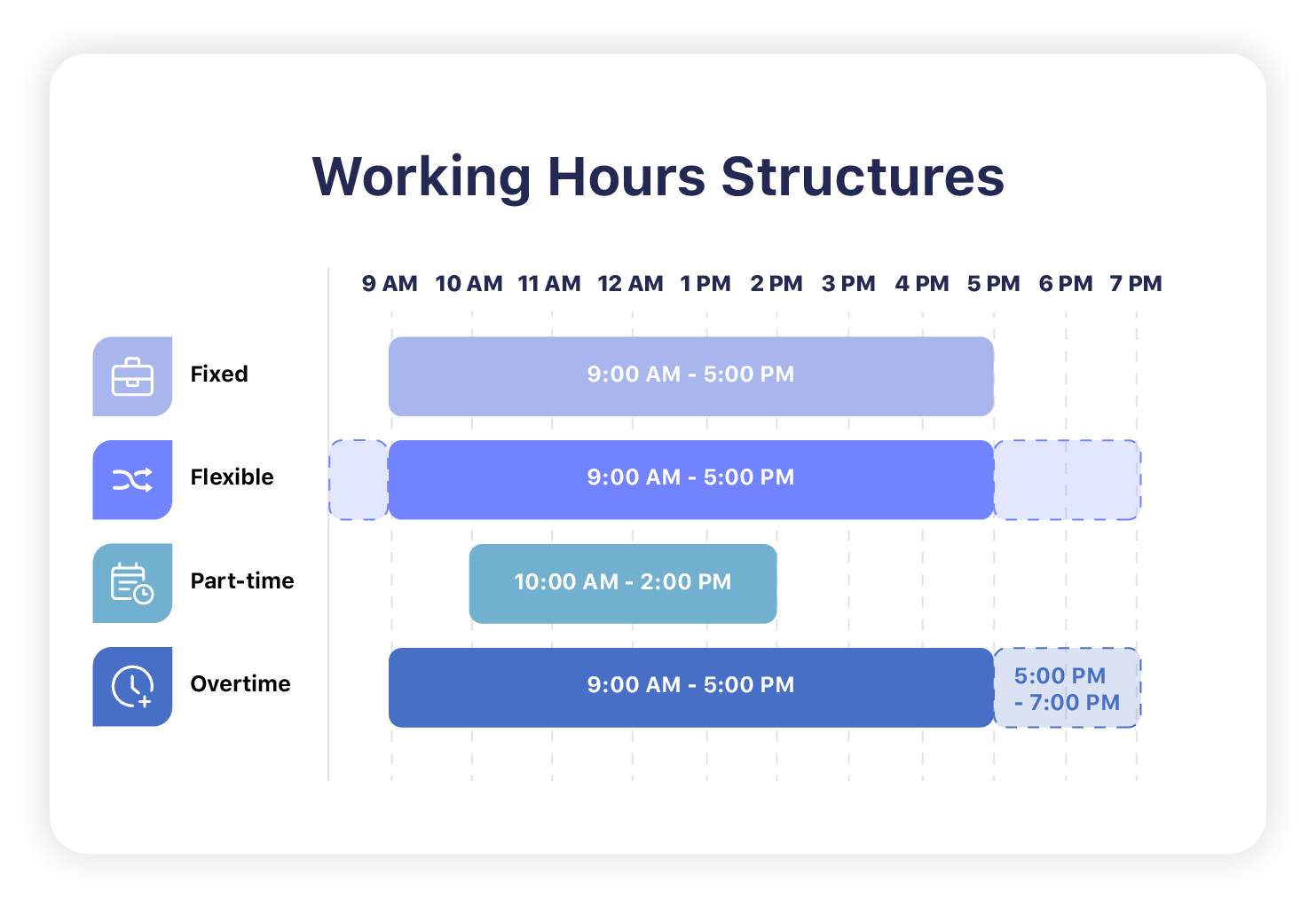
The main types of working hours include standard/fixed, flexible, part-time, and overtime schedules, each used depending on team structure and workload needs.
They can be structured in different ways depending on the role, team, industry, and coverage needs. Some organizations use fixed hours to keep everyone aligned, while others use flexible or shift-based models to support different schedule patterns.
Standard Hours
Standard work hours follow a fixed schedule with defined start and end times, such as 9 AM to 5 PM, Monday through Friday. This structure is common in teams that need predictable availability and synchronous collaboration during the workday.
✅ Typical Structure: 9 AM–5 PM, Monday to Friday
🎯 Best for: office-based teams, administrative roles, finance and accounting teams, professional services, agencies, and teams that rely on real-time collaboration.
Flexible Hours
Flexible work hours allow employees to choose their start and end times within agreed limits. For example, a team may require core availability from 10 AM to 3 PM while allowing employees to complete the rest of their hours earlier or later.
Companies use this model to support autonomy, work-life balance, and hybrid work arrangements.
✅ Typical Structure: flexible start and end times, often with core hours such as 10 AM–3 PM
🎯 Best for: hybrid teams, remote teams, knowledge workers, creative roles, and teams focused on outcomes rather than fixed availability.
👉 For a deeper look, see how flexible hours operate in practice in our guide to flex time.
Part-Time Hours
Part-time work hours involve fewer weekly hours than a full-time role. A part-time employee may work a reduced schedule, such as 20 or 30 hours per week, depending on the role and business needs.
This structure is often used for flexible staffing, specialized roles, or positions that do not require full-time coverage.
✅ Typical Structure: reduced weekly hours, such as 20–30 hours per week
🎯 Best for: support roles, specialized contributors, and teams that need flexible or partial coverage.
Overtime hours
Overtime refers to additional hours worked beyond an employee’s standard working hours. Organizations may use overtime to handle busy periods, urgent projects, staffing gaps, or deadlines.
Because overtime affects workload planning and attendance records, it should be clearly tracked and managed.
✅ Typical Structure: hours beyond the standard schedule (e.g., 45+ hours per week or extended daily shifts)
🎯 Best for: peak periods, project-based tasks, operations teams, and roles with fluctuating or deadline-driven workloads
💡 For more context on how overtime functions in practice, see our guide to overtime management.
Other types: shift-based & compressed workweek
Some organizations also use other working hour structures, such as:
- Shift-based hours: Work is divided into scheduled blocks, such as morning, afternoon, evening, or night shifts. This is common in teams that need extended or continuous coverage.
- Compressed workweeks: Employees work the same total weekly hours in fewer days, such as four longer workdays instead of five standard days.
Examples of Work Hour Structures
Working hours become easier to understand when you see how they look in real teams. Here are real-life examples of work hour structures:
Example of Standard hours
Typical examples of standard work hours include office teams, admin roles, and finance or accounting teams that need everyone available during the same business hours to coordinate work, review information, and manage approvals.
This structure works best when collaboration depends on predictable availability and most tasks happen during regular working hours.
Example of Flexible Hours
A common example of flexible work hours is a hybrid or remote team that sets 10 AM to 3 PM as core hours, while allowing employees to complete the rest of their work earlier or later. For instance, one person may work 7 AM to 3 PM, while another works 10 AM to 6 PM.
This structure works well when teams need a shared window for meetings, handoffs, and collaboration, while still giving individuals control over when they start and finish their workday.
Example of Part-Time Hours
A common example of part-time working hours is a special contributor (e.g., designer or content creator) or support role working 4 hours per day or around 20 hours per week, focusing on specific tasks or projects. Their schedule may be fixed or flexible depending on the role.
This structure works well when full-time coverage is not required or when teams need specialized support without allocating a full-time role.
Example of Overtime
A typical example of overtime hours is a team extending its normal schedule during a product launch, an urgent deadline, or a busy period. For example, employees may work extra hours in the evening or exceed 45 hours in a week to complete critical work.
This structure is usually temporary and works best when teams need to handle workload spikes, urgent tasks, or unexpected demands.
💡 For a deeper look at how different work schedules operate in practice, see our guide to employee work schedules.
Working Hours vs Schedule vs Shift
The terms working hours, work schedule, and shift are closely related but refer to different aspects of how work time is defined and organized. Here’s a quick comparison table to understand the difference between each concept.
| Concept | What It Refers To | Example |
|---|---|---|
| Working hours | The total amount of time an employee is expected to work | 40 hours per week |
| Work schedule | How those hours are distributed across days and times | Monday–Friday, 9 AM–5 PM |
| Shift | A specific block of scheduled work within a schedule | Night shift: 10 PM–6 AM |
While they are often used interchangeably, these concepts operate at different levels. Working hours define the total time expected, the schedule determines when that time is worked, and shifts break that schedule into specific working blocks.
Why Work Hours Matter for Planning and Team Coordination
Work hours give teams a shared structure for organizing work. When they are clearly defined, managers can plan resources more realistically, and employees know what is expected from them.
Clear office hours help organizations:
- Maintain reliable coverage: Teams can make sure the right people are available when customers, projects, or internal operations need attention.
- Plan workloads more accurately: Managers can understand how much work can realistically fit into a day or week.
- Coordinate across roles and teams: Shared availability makes meetings, handoffs, approvals, and collaboration easier to manage.
- Set clearer expectations: Employees know when they are expected to be available, when work should happen, and how their time connects to team needs.
- Identify workload issues earlier: When expected hours and actual work patterns are visible, teams can spot overwork, idle capacity, or coverage gaps before they become bigger problems.
In this sense, working hours are not only a scheduling detail. They are part of how teams manage capacity, protect focus, and keep work moving consistently. This is why organizations rely on time and attendance systems to maintain visibility and ensure working hours are followed in practice.
How Work Hours Are Tracked
Once working hours are defined, teams need a clear process to see whether those hours are being followed, adjusted, or exceeded in a daily routine.
Tracking work hours helps organizations understand not only when people are expected to perform their job, but also how work time actually happens across the team.
Common ways to track working hours include:
- Timesheets: employees log the hours they worked over a day or week, often broken down by task, project, or client.
- Clock-in / clock-out systems: employees record when they start and finish work, creating a clear record of time worked.
- Digital time tracking tools: these tools track time automatically or manually, helping teams understand how work hours are spent across tasks and activities.
- Attendance systems: used to monitor presence, absences, and overall adherence to expected working hours.
A key concept in tracking work time is the difference between planned hours and actual hours worked. By comparing both, organizations can:
- Identify gaps in coverage
- Detect overload or excessive overtime
- Improve planning accuracy
- Maintain better visibility across teams
Here’s where time and attendance systems play a critical role. They help organizations track when employees actually work, compare planned and real hours, and maintain visibility across teams. This level of visibility is essential for ensuring coverage, managing workloads, and keeping operations aligned with expected working hours.
👉 See how time and attendance and time tracking tools help organizations monitor and organize working time effectively.
Understanding Work Time in Practice
Working hours are the foundation of how work is organized. They define when work happens, how time is structured, and how teams stay aligned on availability and expectations.
When work time is clearly defined, organizations can ensure consistent coverage, plan workloads more effectively, and coordinate work across teams without friction. And when those hours are properly tracked, teams gain visibility into how time is actually used, making it easier to identify gaps, adjust capacity, and keep work on track.
In practice, working hours are about structure, coordination, and clarity. When used effectively, they help teams operate more predictably and make better decisions about how work is planned and executed.
👉 Explore how time and attendance resources support better visibility, tracking, and control over working hours across teams.
Frequently Asked Questions about Working Hours
What are working hours in a job?
Working hours are the periods of time when an employee is expected to work. They usually define start and end times, total daily or weekly hours, and expected availability.
How are working hours structured in companies?
Companies structure working hours by defining daily or weekly hours, start and end times, breaks, core hours, flexible ranges, and coverage requirements across teams.
What are the different types of working hours?
Common types of working hours include standard hours, flexible hours, part-time hours, overtime hours, shift-based hours, and compressed workweeks.
What is considered full-time working hours?
Full-time working hours usually refer to a standard weekly schedule, often around 35 to 40 hours per week. The exact definition can vary by company, role, or country.
What is the difference between working hours and shifts?
Working hours refer to the total time an employee is expected to work. A shift is a specific scheduled block of work, such as 8 AM to 4 PM or 10 PM to 6 AM.
How do I calculate working hours?
To calculate working hours, subtract the start time from the end time, then deduct unpaid breaks. For weekly totals, add the hours worked across each workday.
How many hours is a 9 to 5 schedule?
A 9 to 5 schedule covers 8 hours in total. If it includes a one-hour unpaid lunch break, it usually counts as 7 paid working hours.
What is meant by working time?
Working time means the time an employee spends performing job-related work. It can include scheduled hours, active work time, and sometimes paid breaks, depending on company rules.


